Germany Opportunity Card for Sri Lankans: 2026 Guide | Malirosa Pvt Ltd
Share
Visa & Pathways13 min read
Germany Opportunity Card (Chancenkarte) for Sri Lankans: Complete 2026 Guide
The Germany Opportunity Card (Chancenkarte) lets qualified professionals enter Germany for up to 12 months to find skilled work, with no job offer required. Updated for 2026: full points table, documents checklist, realistic timeline, and Sri Lanka-specific guidance on which profiles actually succeed.
Every standard Germany visa for skilled workers requires the same thing first: a job offer from a German employer. Getting that offer from Sri Lanka, submitting remotely, waiting weeks for responses, and interviewing across a six-hour time difference, has a low success rate. Most candidates never get past the application stage.
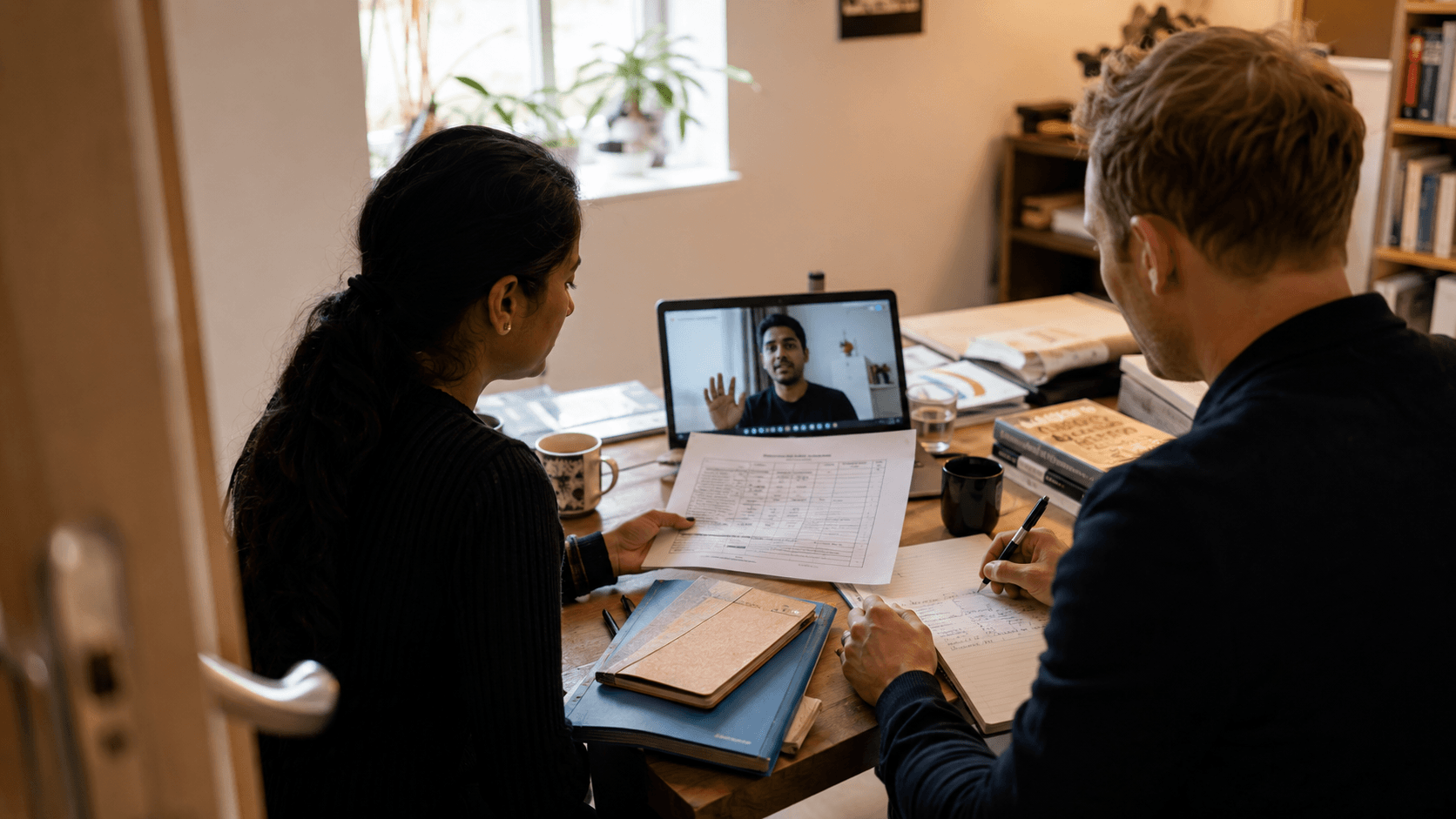
The Chancenkarte changes that. Launched in June 2024 under §20a of the German Residence Act (Aufenthaltsgesetz), the Opportunity Card allows qualified professionals to enter Germany for up to 12 months without any employer commitment. You arrive. You search in person. You interview face to face. Employers tell MALIROSA consistently that response rates for candidates already in Germany are three to four times higher than for remote applicants.
For the right candidate, qualified, language-ready, and financially prepared, the Chancenkarte is the most practical new Germany immigration route in years. But it has a real points system, specific financial thresholds, and a 12-month clock that starts when you land. This guide covers every detail, updated for 2026, with specific guidance for Sri Lankan applicants.
What Is the Germany Opportunity Card (Chancenkarte)?
The Germany Opportunity Card (Chancenkarte, §20a AufenthG) is a points-based residence permit that allows qualified non-EU professionals to live in Germany for up to 12 months without a job offer. During that period, holders can work part-time up to 20 hours per week in any sector, attend job interviews, and complete trial employment periods (Probebeschäftigung) of up to two weeks with potential employers. Once a qualifying job is secured, the Chancenkarte converts directly to a full work permit, without returning to Sri Lanka.
Germany faces a structural skilled-labour shortage that deepens annually. The Federal Institute for Vocational Education and Training (BIBB) estimates Germany needs 400,000 additional skilled workers per year to sustain current economic output. (Source: BIBB Berufsbildungsbericht, 2024). The Chancenkarte is Germany's direct response: a mechanism to bring qualified people in before they have an employer, so the job search happens on German soil.
The Chancenkarte is not renewable as a Chancenkarte. After 12 months, you must have converted to a work permit or you must leave. This is not a staging ground for indefinite residence. It is a structured 12-month job-search window with a clear conversion path at the end. MALIROSA strongly advises candidates to have B2 German and a sector plan before applying, not after arriving.
Chancenkarte Points System 2026: Full Breakdown for Sri Lankan Applicants
There are two routes to qualify. You only need to satisfy one.
Route A: Direct Qualification Recognition. If your foreign university degree or vocational qualification has been formally assessed as equivalent to a German standard (gleichwertig), you may qualify directly without reaching 6 points. Check your degree on the official German Anabin database at anabin.kmk.org. Degrees from the University of Colombo, University of Moratuwa, and University of Peradeniya are indexed, many carrying H+ or H++ ratings, which indicates direct equivalency.
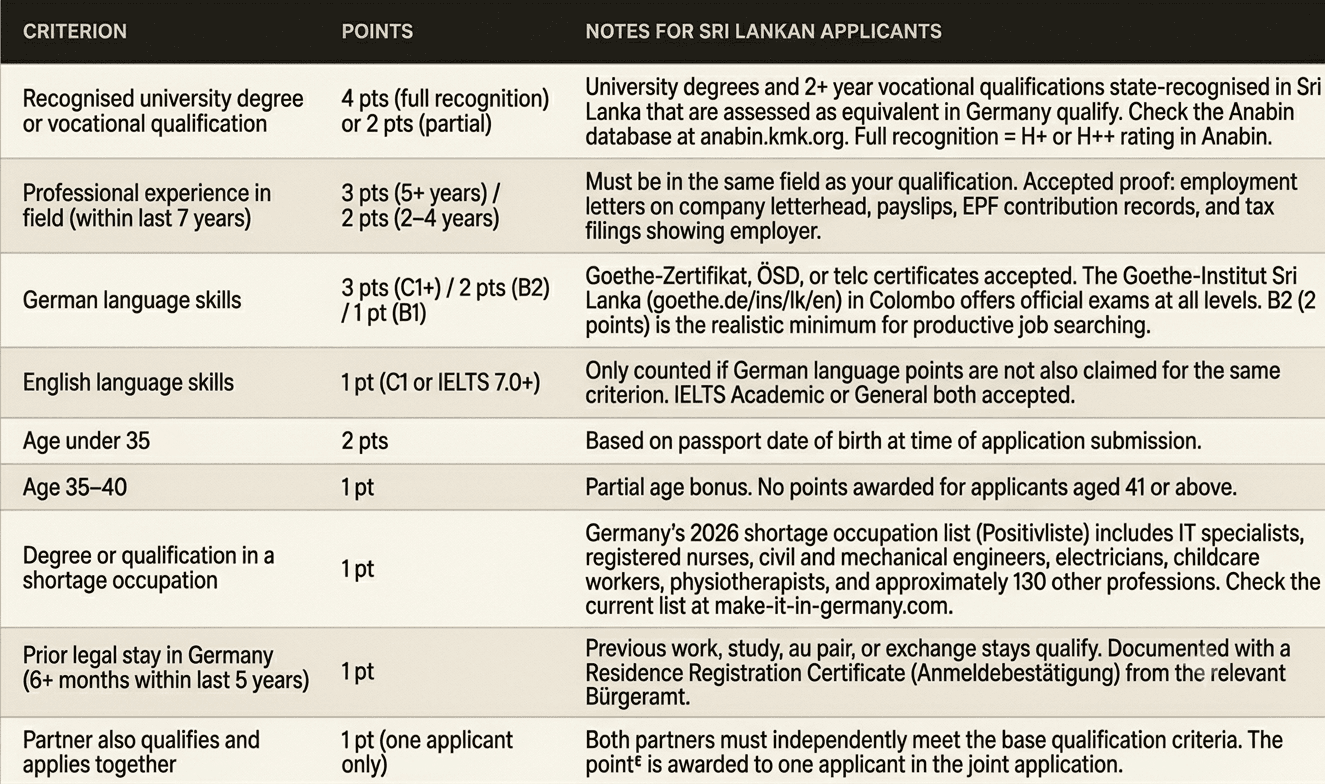
Route B: Points System (minimum 6 points). If your qualification is not yet recognised, or recognition is in progress, you apply via the points system. The full 2026 breakdown is below.
What Sri Lankan Candidates Actually Score: Four Worked Examples
To make the points system concrete, here are four candidate profiles MALIROSA frequently assesses, with honest notes on employability, not just eligibility.
IT engineer, 28 years old, BSc Computer Science from University of Moratuwa (H+ Anabin rating), B2 German (Goethe-Zertifikat), 3 years experience at a Colombo tech company, IT is a shortage occupation: 4 (degree, full recognition) + 2 (experience, 2–4 years) + 2 (B2 German) + 2 (age under 35) + 1 (shortage occupation) = 11 points. Strong candidate. B2 German adequate for most interviews in the German tech sector.
Registered nurse, 33 years old, BSc Nursing from UGC-approved Sri Lankan university, B2 German, 4 years hospital experience: 4 + 2 + 2 + 2 + 1 (nursing shortage) = 11 points. Excellent candidate. Germany has a structural nursing shortage; Sri Lankan BSc Nursing is well-understood by German state nursing authorities (Pflegekammern), and recognition typically takes 3–6 months.
Hotel management graduate, 38 years old, HND from a recognised Sri Lankan institution, A2 German, 3 years resort management experience: 4 (partial recognition, HND) + 2 (experience) + 0 (A2 below B1 threshold) + 1 (age 35–40) = 7 points. Eligible on paper. Realistically, finding a hospitality management position in Germany within 12 months at A2 German is very difficult; most employers conduct interviews in German. MALIROSA would advise reaching B1 before applying.
Recent accounting graduate, 23 years old, BSc Accounting from private institution (not yet Anabin-assessed), no German, no work experience: 2 (partial credit pending assessment) + 0 + 0 + 2 (age) = 4 points. Below the 6-point threshold. MALIROSA would advise this candidate to pursue the Ausbildung route or Student Visa instead, and to start German language training immediately.
Which Sri Lankan Candidates Are Best Positioned for the Chancenkarte?
Based on MALIROSA's direct assessment of Sri Lankan candidate profiles and Germany's 2026 labour market, these four groups have the strongest combination of eligibility and real-world employability:
IT professionals with degrees from Moratuwa, Colombo, or SLIIT. Software engineers, data analysts, cybersecurity specialists, and ERP consultants. Germany's federal digital transformation agenda (Source: Bundesministerium für Digitales, 2024) is driving demand in both the private sector and the public sector. B2 German is strongly recommended; many German tech companies operate internally in German even when products are in English.
Registered nurses and allied health professionals. Sri Lankan nurses with a BSc Nursing from a UGC-approved institution and B2 German are among the most actively sought international candidates by German healthcare employers. Recognition goes through the relevant state nursing authority (Pflegekammer or Bezirksregierung) and is now well-established for Sri Lankan applicants. Allow 3–6 months for the formal recognition decision.
Mechanical and civil engineers from Moratuwa or Peradeniya with 3+ years of industry experience. Sectors with highest demand: automotive supply chain (Baden-Württemberg and Bavaria), infrastructure and civil construction (across Germany), and industrial machinery manufacturing. German B2 is expected by most engineering employers; B1 is the minimum for smaller companies in non-urban areas.
Experienced hospitality managers with 3+ years in hotel or resort management and minimum B1 German. Germany's domestic tourism sector saw a record 494 million overnight stays in 2023 (Source: Destatis, 2024), sustaining high demand for mid-management hotel professionals. Candidates targeting resort regions and secondary cities have better prospects than those targeting Berlin or Munich, where competition is highest.
How to Apply for the Chancenkarte from Sri Lanka: 8 Steps
The application process has eight stages. Each must be completed in order; incomplete applications submitted at VFS Global Colombo cause delays, and appointment slots are limited.
Check your qualification on the Anabin database. Go to anabin.kmk.org and search for your institution and degree programme. An H+ or H++ rating with "gleichwertig" (equivalent) status is your strongest starting position. If your institution is not listed, contact the German NARIC (anabin.kmk.org/kontakt.html) or use the official recognition advisory portal anerkennungsberatung.de. MALIROSA can help you interpret these assessments.
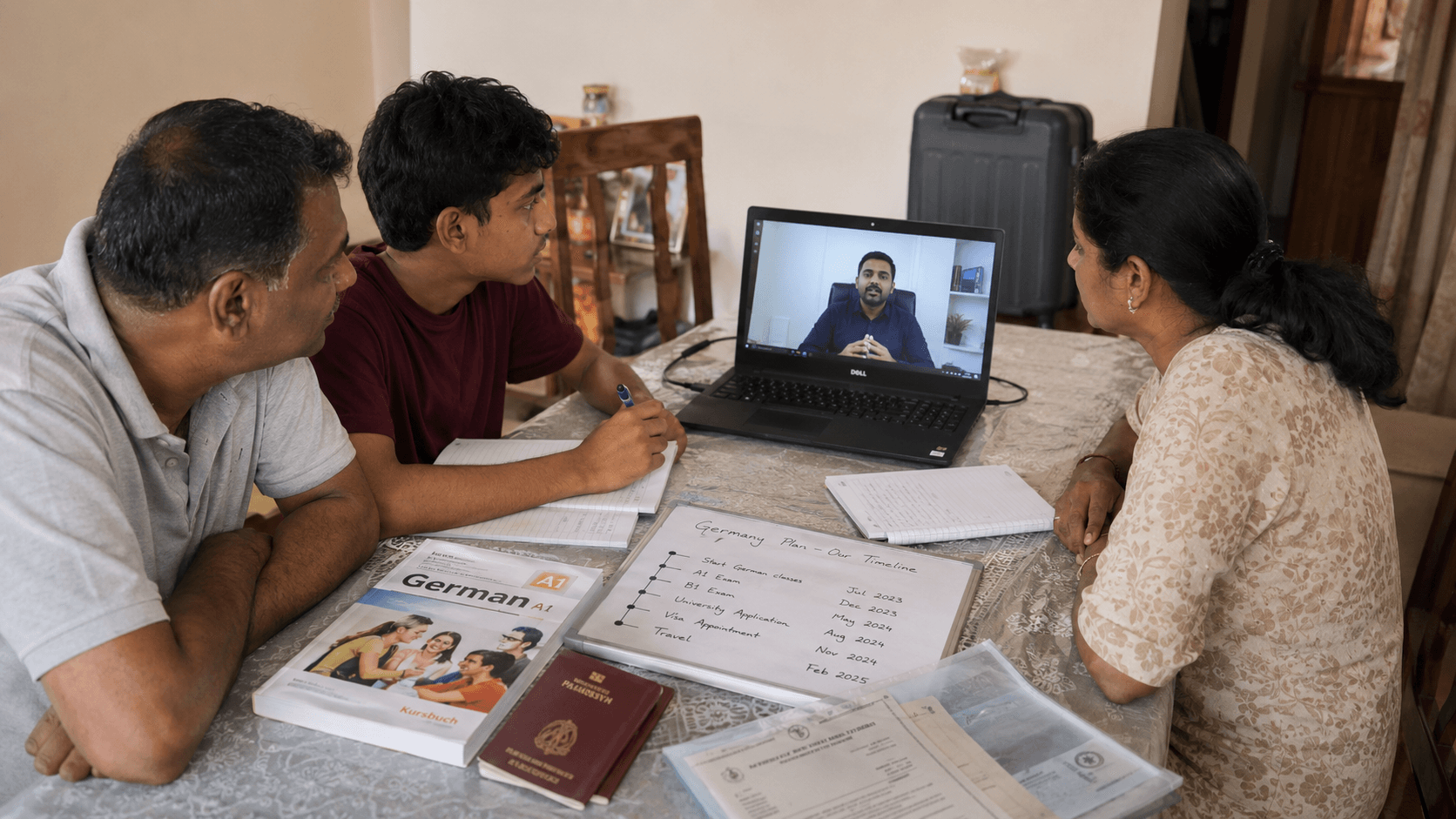
Reach B2 German before applying. Most Sri Lankan adult learners starting from A1 reach B2 in 12–18 months with structured study of 10–12 hours per week. MALIROSA's German language courses are designed specifically for candidates preparing for the German job market, aligned with Goethe-Institut exam formats and taught by certified instructors. The Goethe-Institut Sri Lanka (goethe.de/ins/lk/en) in Colombo conducts official B1 and B2 examinations.
Get your qualification documents certified and translated. All educational certificates not in German or English must be translated into German by a sworn translator (vereidigter Übersetzer) on the German Embassy Colombo approved list. Standard university degree translation costs LKR 15,000–30,000 per document. Allow 4–6 weeks.
Open a German blocked account (Sperrkonto) and deposit €13,092. This is the 2026 12-month self-sufficiency requirement (€1,091/month). Providers such as Fintiba, Coracle, and expatrio accept applications from Sri Lanka and can hold funds in a German-regulated account. Allow 2–4 weeks for account setup and international bank transfer settlement.
Prepare your complete document set. See the checklist in the following section. Assemble everything before booking your VFS appointment; submitting incomplete files wastes your appointment slot.
Book your appointment at VFS Global Colombo. The German Embassy has authorised VFS Global as its visa processing centre for Sri Lanka. Book at visa.vfsglobal.com (select Germany / Sri Lanka). Slots fill 4–8 weeks in advance during peak periods (March–August). Application fee: €75, payable in LKR at the prevailing exchange rate on the appointment date.
Attend your appointment and submit your documents. Biometric data (fingerprints and a live photograph) will be collected at this appointment. Embassy processing after a complete submission currently takes 6–12 weeks. Incomplete files are returned, not processed.
Arrive in Germany and register within 14 days. Your entry document is a national visa (Typ D). On arrival, register your address at the local Bürgeramt. Then visit the Ausländerbehörde to exchange your entry visa for the physical Chancenkarte residence permit. Your 12-month job-search period begins from your arrival date, not from the visa issue date.
Complete Documents Checklist for Chancenkarte Applications from Sri Lanka
Prepare two complete, collated sets of all documents. VFS Global retains one set; the second is returned after processing. Originals or certified copies are required; photocopies alone are not accepted. For the full certified translation and apostille process, see our Germany visa documents guide for Sri Lankan applicants.
Valid passport: minimum 18 months validity beyond intended departure. Include certified copies of all pages with previous visas and entry/exit stamps.
Completed national visa application form: downloadable from the German Embassy Colombo website (colombo.diplo.de). Must be signed and dated by the applicant.
Two recent biometric passport photographs: white background, taken within the last 6 months. Dimensions per German embassy standard: 35x45mm.
University degree certificate(s): original + notarised copy + certified German translation by a sworn translator.
Academic transcripts: original + certified German translation.
Proof of qualification recognition: Anabin database printout showing institution and degree rating, or formal recognition decision (Gleichwertigkeitsfeststellung) from a German recognition authority.
German language certificate: Goethe-Zertifikat, telc, or ÖSD certificate at your claimed level. Must be original or certified copy. Online course certificates not accepted.
Curriculum Vitae (Lebenslauf): in German, European Europass format, dated and signed.
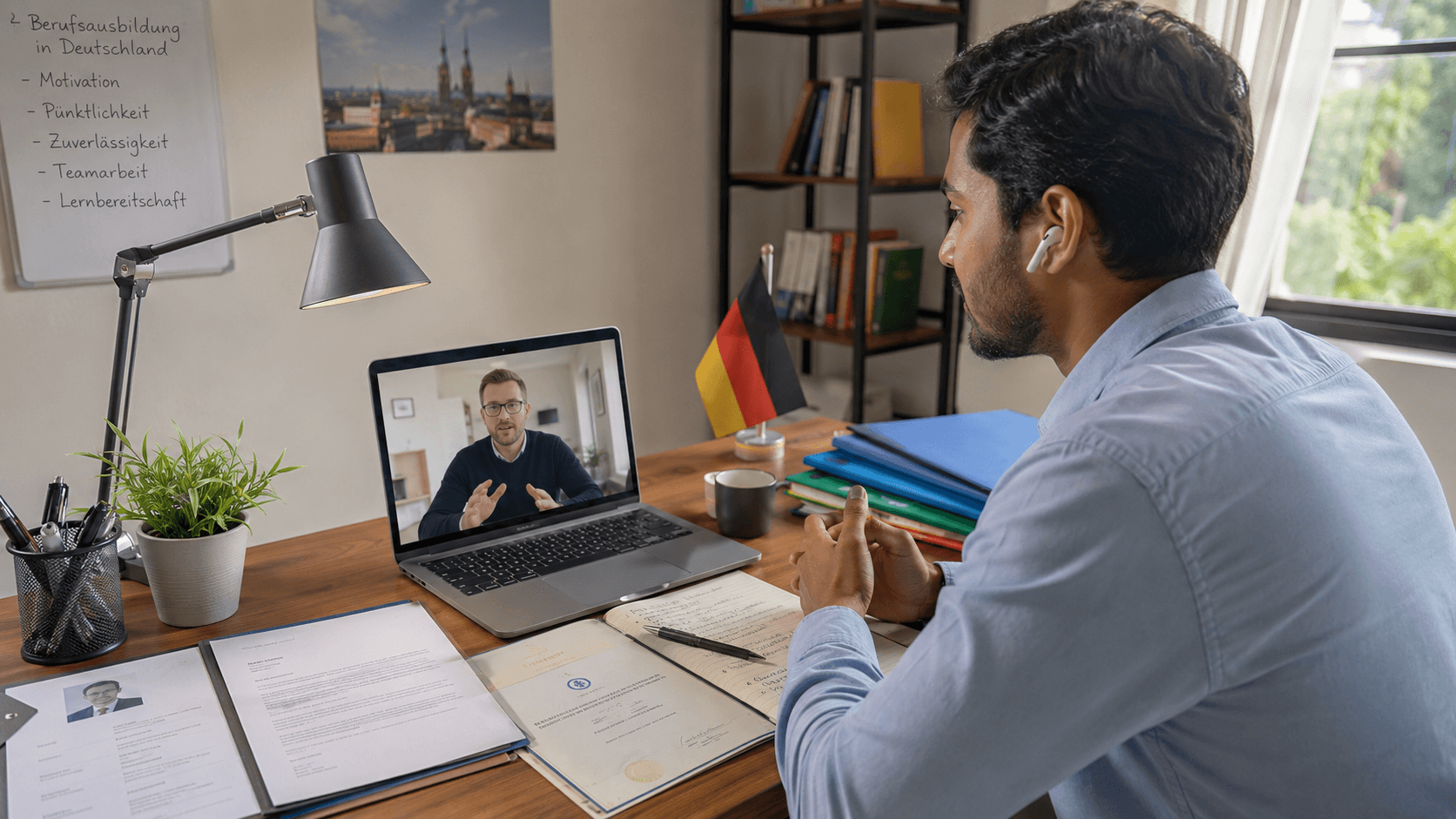
Cover letter / motivation statement: in German. Should explain your professional background, your target job sector in Germany, and your concrete plan for the Chancenkarte year. Keep to one A4 page.
Proof of professional experience: employment letters on company letterhead (job title, dates, and core duties). Supplement with payslips and EPF contribution history.
Proof of financial means: Sperrkonto (blocked account) statement showing minimum €13,092 balance, or a Verpflichtungserklärung (Declaration of Commitment) from a German-resident sponsor.
Health insurance covering Germany: valid for the full entry period (minimum 12 months recommended). International travel insurance with health cover is accepted for the initial entry; German public or private insurance once registered.
Proof of accommodation in Germany: hotel booking confirmation, short-term rental agreement, or an invitation letter from a German-resident host stating your address and confirming accommodation.
Points calculation worksheet (optional but recommended): a self-prepared document totalling your claimed points with the corresponding evidence for each criterion. Makes the file easier for the visa officer to review.
Realistic Timeline: Sri Lanka to Germany on the Chancenkarte
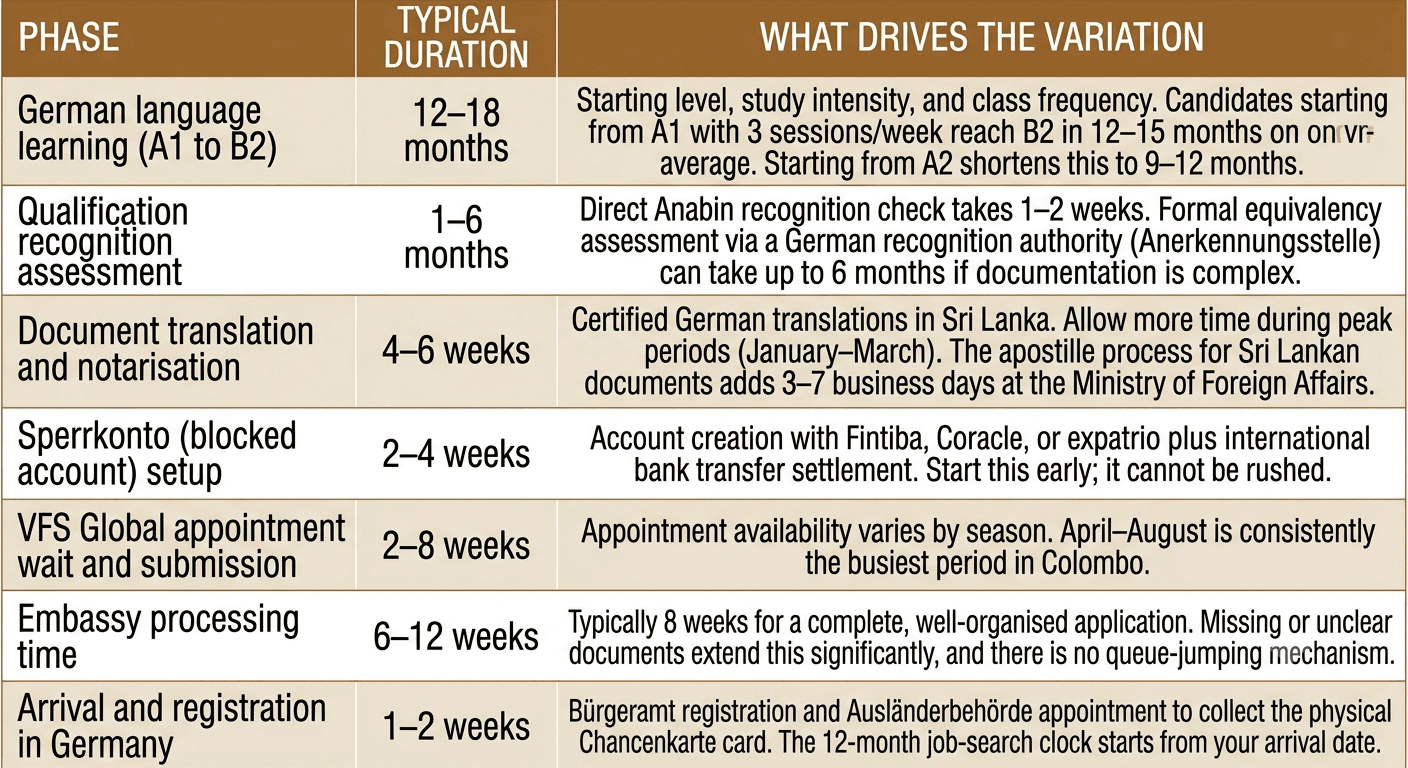
Most Sri Lankan candidates underestimate the preparation phase. The Chancenkarte is a multi-stage process. Below is the honest timeline; plan from the start, not the end.
Chancenkarte vs Skilled Worker Visa vs Student Visa: When to Choose Which
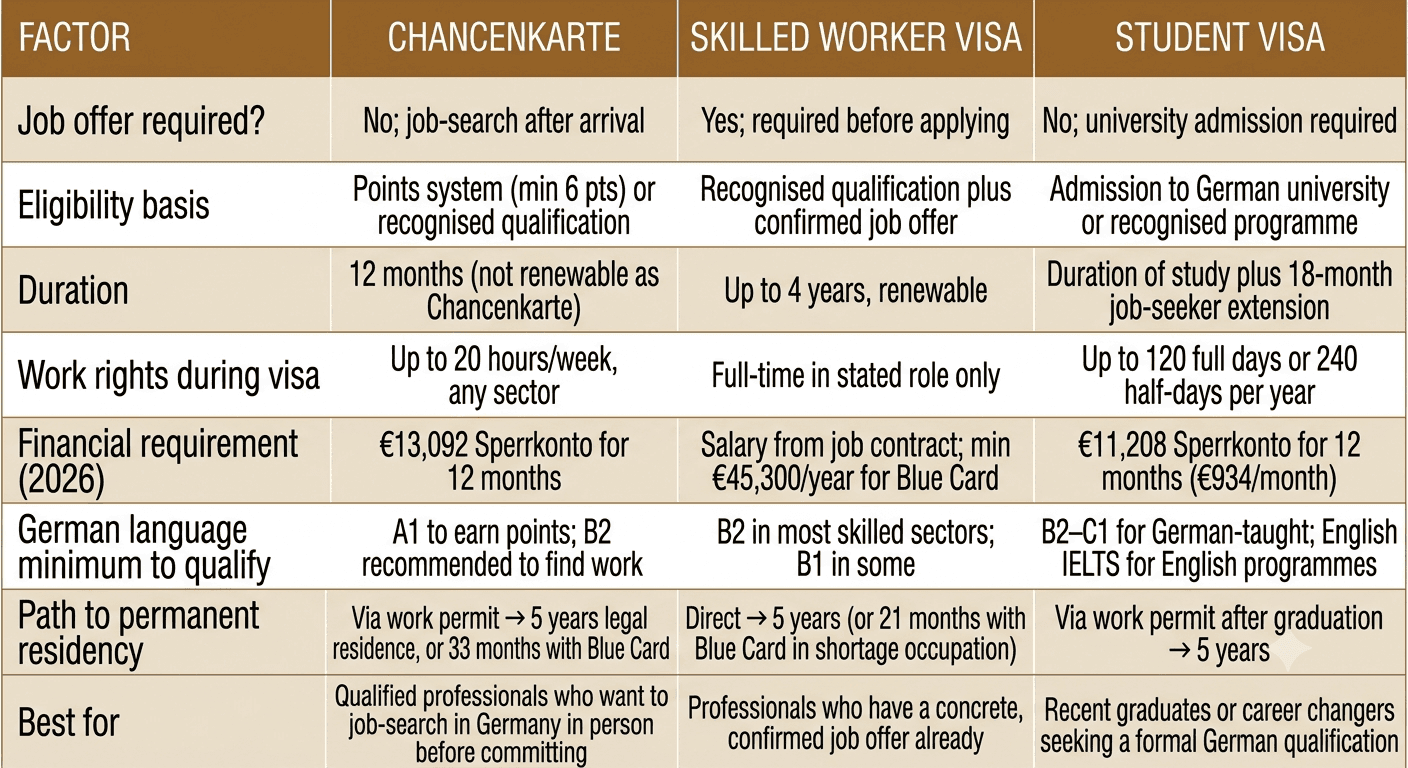
The Chancenkarte is one of several Germany visa pathways for Sri Lankan professionals. The table below shows where each route works best. Choose the one that fits your current profile, not the one that sounds fastest on paper.
What the Chancenkarte Is and Is Not: An Honest Assessment
The Chancenkarte is a genuine opportunity for the right candidate. It is not a shortcut or a guaranteed route to employment. These are the facts you need to plan around:
Job searching in Germany in person is substantially more effective than remote applications. Response rates are 3–4 times higher for candidates already in Germany; this is the single biggest advantage the Chancenkarte offers.
You will need functional German. Most job interviews, even at companies with English-language products, are conducted in German. A1 earns you eligibility points; it will not get you through a job interview. B2 is the practical working standard.
Living costs in German cities run €1,000–1,500/month including rent, food, and local transport. Stuttgart, Frankfurt, and Munich are at the higher end. Smaller cities (Nuremberg, Dortmund, Leipzig) are 20–30% cheaper. Your Sperrkonto must cover the full 12 months regardless.
The 20-hour part-time work allowance can offset some costs. Casual positions in hospitality, logistics, and retail are available for candidates with basic German. These do not count toward your qualification assessment but do provide income.
Conversion to a work permit is generally smooth once an offer is secured; you apply at the Ausländerbehörde in your German city, and no return to Sri Lanka is required. The process takes 2–6 weeks.
There are no extensions to the 12-month period. If you have not secured qualifying employment by month 12, you must leave Germany. MALIROSA advises candidates to begin applying actively from week one, not after settling in.
MALIROSA does not guarantee visa approval or employment outcomes. We help you build the strongest application, understand the process accurately, and enter Germany as a well-prepared candidate.
MALIROSA Chancenkarte Consulting for Sri Lankan Candidates
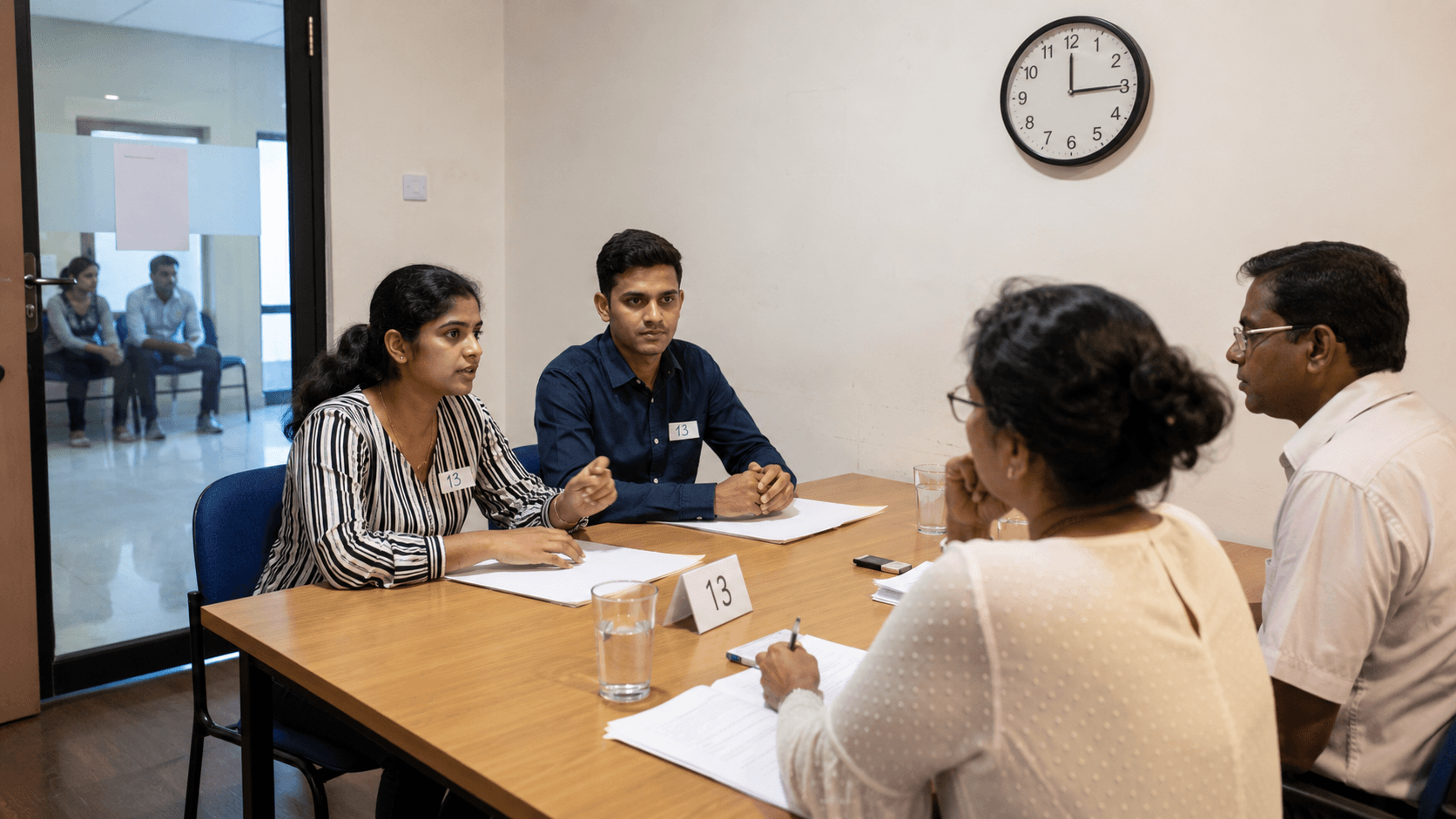
MALIROSA offers dedicated Chancenkarte consulting for Sri Lankan candidates, from free eligibility assessment through to embassy interview preparation. Our team is based in both Sri Lanka and Germany. Robert Saiger brings direct experience of German employer expectations and the Chancenkarte regulatory framework. Randima Saiger brings understanding of where Sri Lankan candidates typically need the most support in the application process.
The first step is a free 30-minute assessment call. We calculate your exact points score, review your qualification recognition status, assess your realistic employability in Germany's current labour market, and give you an honest verdict on whether the Chancenkarte, Ausbildung, or Skilled Worker route is the better fit for your specific profile.
If you are ready to start German language preparation in parallel, which MALIROSA always recommends, our online German courses A1–B2 are structured specifically for candidates targeting German employment. Most candidates begin language training and qualification assessment simultaneously to avoid losing 12–18 months.
Continue Your Journey
Get structured guidance on every Germany visa pathway.
Robert Saiger is a co-founder of MALIROSA with a background in Industrial Engineering & Management and Certified Consultant & Coach. Based in Konstanz, Germany, he brings direct expertise in Germany visa pathways, employer expectations, and the Sri Lankan qualification system.
What is the Germany Opportunity Card (Chancenkarte)?
The Germany Opportunity Card (Chancenkarte) is a points-based residence permit launched in June 2024 under §20a of the German Residence Act. It allows qualified non-EU professionals to live in Germany for up to 12 months without a job offer. Holders can search for work in person, attend interviews, and complete trial employment periods of up to two weeks per employer. Once a qualifying job offer is secured, the Chancenkarte converts directly to a full work permit, without returning to Sri Lanka.
How many points do I need for the Chancenkarte?
You need a minimum of 6 points. Points are awarded for your qualification (up to 4 for a fully recognised degree), professional experience (up to 3 for 5+ years in field), German language level (up to 3 for C1+), age (2 if under 35, 1 if aged 35–40), prior stay in Germany of 6+ months (1 point), shortage occupation (1 point), and joint application with a qualifying partner (1 point). If your foreign degree is fully recognised as equivalent to a German qualification, you may qualify without the points test.
Can Sri Lankans apply for the Chancenkarte?
Yes. Sri Lankan nationals apply at the German Embassy in Colombo, processed through VFS Global. IT engineers with degrees from Moratuwa, registered nurses with BSc Nursing, mechanical engineers from Peradeniya, and experienced hospitality managers are among the strongest profiles. The most important first step is checking your specific degree and institution in Germany's Anabin database at anabin.kmk.org.
What German language level do I need for the Chancenkarte?
The minimum to earn language points is B1 (1 point). However, MALIROSA strongly recommends reaching B2 before applying. At B1 or below, finding a job in Germany within 12 months is very difficult; most employers interview in German, and the 12-month clock starts on arrival. B2 earns 2 additional points and is the practical baseline for employability in Germany.
How long does the Chancenkarte last?
The Chancenkarte is valid for a maximum of 12 months from your arrival date in Germany. It is not renewable as a Chancenkarte. Within those 12 months you must secure a qualifying job and apply at the Ausländerbehörde to convert to a full work permit. If you have not found qualifying employment by month 12, you must leave Germany.
Can I bring my family on the Chancenkarte?
Family reunification is possible but assessed case by case. The primary applicant must demonstrate sufficient housing and financial means for the whole family. In practice, most holders find it easier to arrange family reunification after converting to a full work permit. One exception: if both partners independently meet the Chancenkarte criteria and apply simultaneously at the same embassy, one partner earns an additional 1 point.
What happens when I find a job on the Chancenkarte?
You apply at the Ausländerbehörde in your German city to convert your Chancenkarte to a full work permit. If your salary meets the threshold (€45,300/year in most sectors for 2026), you can apply for an EU Blue Card instead, which has a faster path to permanent residency (21 months for shortage occupations). You do not need to return to Sri Lanka for this conversion. The process typically takes 2–6 weeks.
How much money do I need for the Chancenkarte in 2026?
The 2026 financial self-sufficiency requirement is €1,091 per month, or €13,092 for a full 12-month stay. The most common method is a German blocked account (Sperrkonto) with this amount deposited before departure. Fintiba, Coracle, and expatrio are providers accessible from Sri Lanka. Allow 2–4 weeks for account setup and fund transfer.
How long does the Chancenkarte application take from Sri Lanka?
After submitting a complete application at VFS Global Colombo, allow 6–12 weeks for embassy processing. The total preparation timeline, from starting German language courses through to arriving in Germany, is typically 14–24 months for candidates starting from zero German. Candidates with B2 German and a recognised degree already in hand can often complete preparation in 4–6 months.
Do I need a job offer to apply for the Chancenkarte?
No. This is what distinguishes the Chancenkarte from the standard Skilled Worker Visa, which requires a confirmed job offer before applying. With the Chancenkarte you enter Germany first, then search for work in person. You do need a recognised qualification (or 6+ points), financial means to sustain yourself, and, practically speaking, B2 German to make the job search realistic.
Find Out If the Chancenkarte Is Right for You: Free 30-Minute Assessment
Every candidate profile is different. The right pathway depends on your qualifications, German level, work experience, and timeline goals. MALIROSA offers a free 30-minute Chancenkarte eligibility assessment: we calculate your exact points score, review your qualification recognition status on the Anabin database, and give you an honest verdict on whether the Chancenkarte, Ausbildung, or Skilled Worker route is the better fit. No sales pitch. No obligation.
How to Move to Germany from Sri Lanka: Your Complete 2026 Pathway Guide
Germany had 1.73 million unfilled skilled-worker positions in 2024. Sri Lanka has hundreds of thousands of educated, ambitious young people with limited local opportunity. This guide is the map that connects those two facts into a plan you can actually follow.
How to Apply for an Ausbildung Visa from Sri Lanka (2026 Step-by-Step Guide)
Most Sri Lankan Ausbildung visa applications are rejected not because candidates lack a training contract, but because their documents are incomplete or incorrectly certified. This step-by-step guide shows you exactly what the German Embassy in Colombo requires and how to avoid the errors that delay most applications by six months.
12 min read
Ausbildung Germany
German Motivation Letter for Ausbildung: What to Write and What Loses You the Place
Most Ausbildung applications fail before anyone reads the CV. The Motivationsschreiben is the first thing a German training company reads, and most international candidates get it completely wrong. Here is what actually works, including a real example.
10 min read
Our Story
Two Worlds, One Purpose: The Story Behind MALIROSA
MALIROSA grew from a decade of living the exact journey that our candidates are about to begin: between Sri Lanka and Germany, between two cultures, two languages, and two very different sets of expectations.
5 min read
Ausbildung
How to Find an Ausbildung Employer in Germany from Sri Lanka (2026 Guide)
You cannot show up in Germany and then find an Ausbildung employer. You need a signed training contract before your visa is approved. This guide covers every active portal, how to write applications German employers actually read, and the realistic timeline from first search to visa approval.