How to Move to Germany from Sri Lanka (2026 Complete Guide) | Malirosa Pvt Ltd
Share
Visa & Pathways
12 min read
How to Move to Germany from Sri Lanka: Your Complete 2026 Pathway Guide
Germany had 1.73 million unfilled skilled-worker positions in 2024. Sri Lanka has hundreds of thousands of educated, ambitious young people with limited local opportunity. This guide is the map that connects those two facts into a plan you can actually follow.
In 2024, Germany posted 1.73 million unfilled skilled-worker positions, a gap so severe the German government passed the Fachkräfteeinwanderungsgesetz (Skilled Worker Immigration Act) specifically to recruit people like you. (Source: Institut der deutschen Wirtschaft / IW Köln, 2024). You do not need connections, a sponsor, or a high income. You need a plan, a language certificate, and the right documents.
Moving to Germany from Sri Lanka follows a structured path. The visa categories are defined by law, the language requirements are published, and the steps are predictable. What stops most candidates is not the system; it is not having a clear map of how the pieces connect and in what order. This is that map.
By the end of this guide you will know which of the five main pathways fits your profile right now, what German level you actually need for each one, what your documents must include, and what to do today.
Why Germany Is the Right Move for Sri Lankan Candidates in 2026
Germany's labour shortage is structural, not cyclical. As the population ages, the working-age pool shrinks; the Federal Statistical Office (Destatis) projects Germany will need 288,000 additional skilled workers per year through 2035 just to maintain current output. That pressure has made German immigration policy more open than at any point in the past two decades.
For Sri Lankan candidates specifically, several factors align well:
The Ausbildung (vocational training) system pays you a monthly salary from day one. The legally guaranteed minimum training wage in 2026 is €724/month in year one, rising to at least €837/month by year three. (Source: Federal Institute for Vocational Education and Training / BIBB, 2026)Sri Lankan university degrees from the University of Colombo, University of Moratuwa, and University of Peradeniya are indexed in Germany's Anabin database, many with H+ or H++ recognition ratings, which significantly speeds up qualification recognitionThe German Embassy in Colombo processes visa applications specifically under the Aufenthaltsgesetz (Residence Act) categories that cover Sri Lankan nationals, and VFS Global is the authorised appointment centre in ColomboAfter completing Ausbildung and working two years in your trained field, you qualify for permanent residency (Niederlassungserlaubnis) under §18b AufenthG, one of the fastest PR routes in GermanyGermany ranked 9th globally on the 2024 UN Human Development Index, with universal healthcare, strong worker protections, and a Sri Lankan community of approximately 27,190 people in Frankfurt, Stuttgart, and Hamburg (Source: UNDP, 2024; Destatis, 2024)
The 5 Pathways to Germany for Sri Lankan Candidates
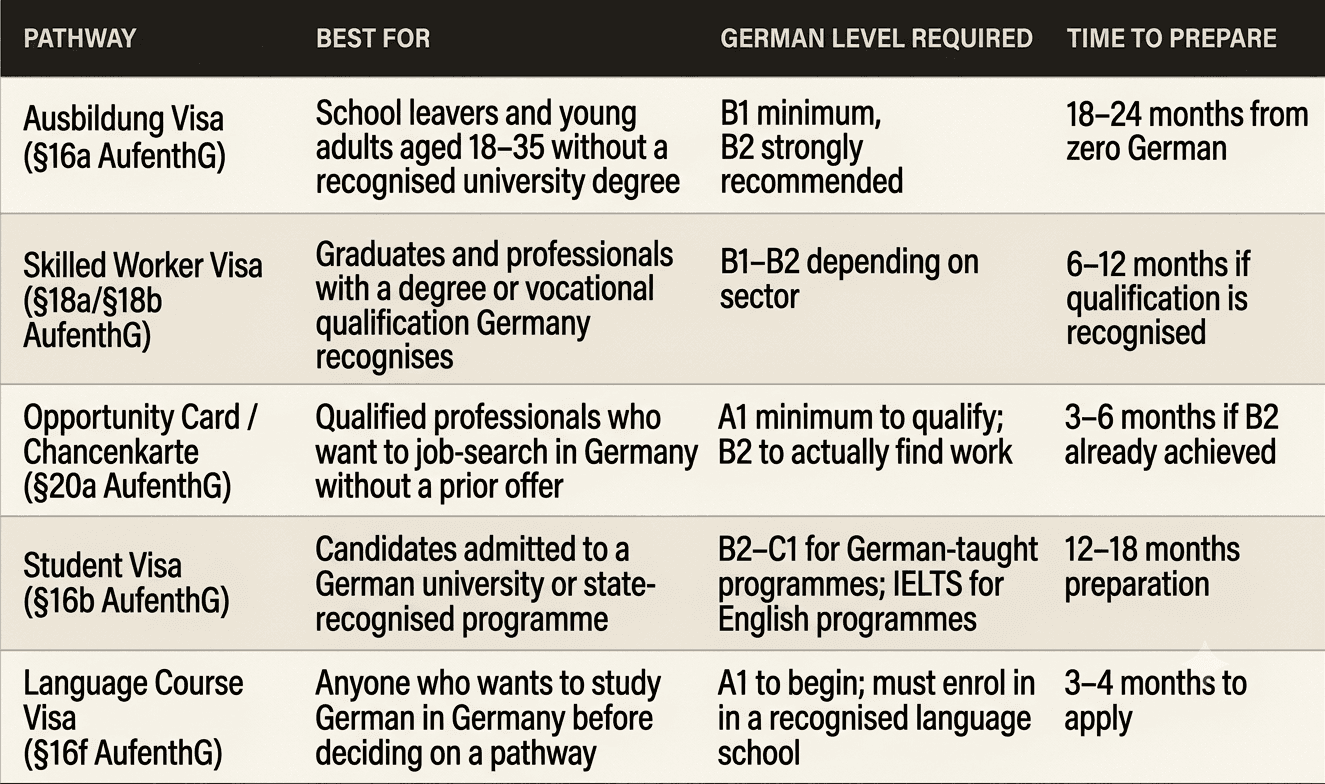
Germany has five immigration tracks relevant to Sri Lankan candidates. Each serves a different profile. Choosing the wrong one wastes months. The table below gives you a one-glance comparison; the detailed sections follow.
Pathway 1: Ausbildung: Learn, Earn, and Get Permanent Residency
The Ausbildung (vocational training) system is Germany's most accessible pathway for Sri Lankan candidates without a university degree. An Ausbildung is a state-recognised, two-to-three-year apprenticeship: you work at a German employer four days per week and attend vocational school (Berufsschule) one or two days per week. You receive a training salary the entire time.
Ausbildung covers more than 325 recognised professions across healthcare, hospitality, logistics, retail, IT, and technical trades. (Source: Federal Institute for Vocational Education and Training / BIBB, 2026). The most in-demand sectors for international candidates are nursing and elderly care (Pflegefachkraft), hotel and restaurant management (Hotelfachmann/Hotelfachfrau), and electrical installation (Elektroniker).
The standard Ausbildung salary range in 2026, by sector: nursing apprentices earn €1,100–1,300/month; hotel and hospitality apprentices earn €800–1,000/month; logistics apprentices earn €750–950/month. (Source: Ausbildung.de salary index, 2026). These are gross figures; apprentices pay reduced tax and social contributions.
After completing Ausbildung: you receive an 18-month job-seeking permit. After two subsequent years of skilled employment in your trained field, you qualify for permanent residency under §18b AufenthG. The total timeline from starting Ausbildung to eligible PR is approximately five years.
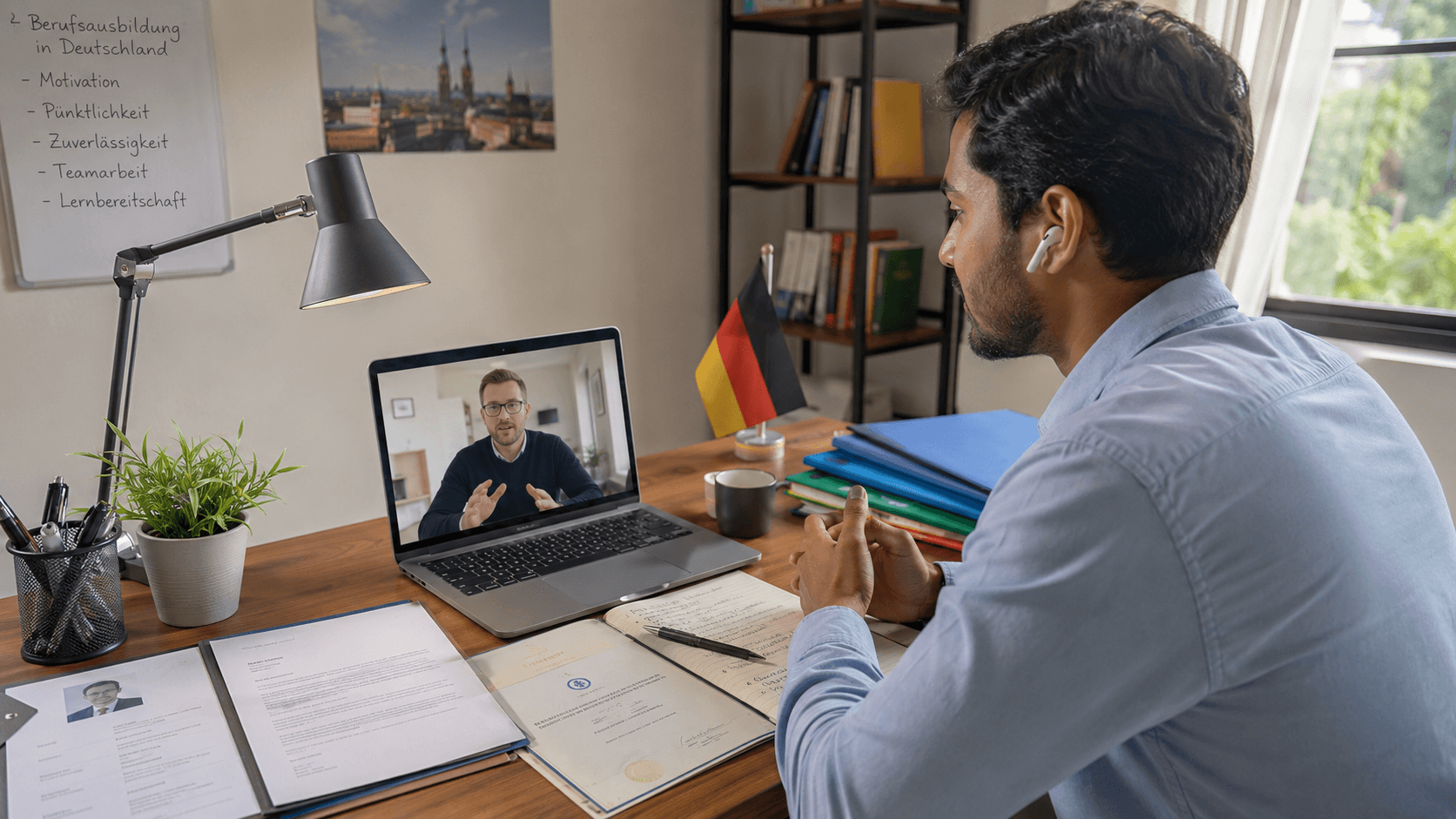
MALIROSA supports Sri Lankan candidates through every stage: language preparation, employer matching, CV and Motivationsschreiben coaching, and document preparation. Our Ausbildung preparation service is structured around the specific requirements of German training companies.
Pathway 2: Skilled Worker Visa: For Graduates with Recognised Qualifications
If you hold a completed university degree or a professionally recognised qualification, the Skilled Worker Visa (§18a or §18b AufenthG) is the most direct route. Germany recognises qualifications from Sri Lanka, but formal recognition through Germany's Anabin database or via the Central Office for Foreign Education (ZAB) is usually required before applying.
Recognised fields with the strongest demand for Sri Lankan candidates include: registered nursing (BSc Nursing from UGC-approved Sri Lankan institutions), mechanical and civil engineering (Faculty of Engineering, Moratuwa or Peradeniya), and IT and software development (degree from Moratuwa, SLIIT, or similar institutions). Healthcare professionals can check qualification recognition at anerkennungsberatung.de, Germany's official recognition advisory portal.
The minimum salary for a Skilled Worker Visa in 2026 is €45,300 per year for most professions. EU Blue Card applicants in shortage occupations qualify at €43,800/year. (Source: German Federal Employment Agency / Bundesagentur für Arbeit, 2026). These thresholds are reviewed annually.
Pathway 3: The Opportunity Card (Chancenkarte): Job-Search Without a Prior Offer
Launched in June 2024, the Chancenkarte (§20a AufenthG) allows qualified professionals to enter Germany for up to 12 months without a job offer already secured. You arrive, attend interviews in person, and convert to a full work permit once you have an offer. You do not need to return to Sri Lanka for the conversion.
The Chancenkarte uses a points system: minimum 6 points required. Points are awarded for your qualification (up to 4 points), professional experience (up to 3 points), German or English language level (up to 3 points), age under 35 (2 points), and prior legal stay in Germany (1 point). A fully recognised Sri Lankan degree alone earns 4 points. Add B2 German (2 points) and age under 35 (2 points), and an IT engineer from Moratuwa scores 8+ points, well above the threshold.
You can work part-time up to 20 hours per week during the Chancenkarte year. Most candidates in hospitality, logistics, or retail find casual work to offset living costs of €1,000–1,500/month in major German cities. For a full breakdown of the points system and Sri Lankan eligibility, see our dedicated Chancenkarte guide for Sri Lankan candidates.
Pathway 4: Student Visa: For Candidates Admitted to a German University
Sri Lankan candidates admitted to a recognised German university or Fachhochschule can apply for a Student Visa (§16b AufenthG). German-taught programmes require B2–C1 German; many universities also offer English-language Masters programmes, particularly in engineering and business, which require IELTS 6.5 or above.
During your studies you can work 120 full days or 240 half-days per year. After graduating, you receive an 18-month job-seeking permit. Germany waives tuition fees at most public universities; you pay a semester contribution of approximately €300–500, which typically covers public transport.
A blocked account (Sperrkonto) of €934/month (2026 rate) is required for the student visa application, approximately €11,208 for a 12-month period. Providers such as Fintiba, Coracle, and expatrio accept applications from Sri Lanka.
Your Step-by-Step Action Plan: From Sri Lanka to Germany
Once you have identified your pathway, preparation follows a predictable sequence. Complete each step fully before moving to the next; partial preparation is the most common cause of delays.
Assess your profile honestly. Write down: your age, your education level, your current German level (if any), and the sectors you would realistically work in. Be specific. A 28-year-old with a completed BSc Nursing and zero German is a different profile from a 22-year-old school leaver with A2 German. Each profile has a different best pathway.
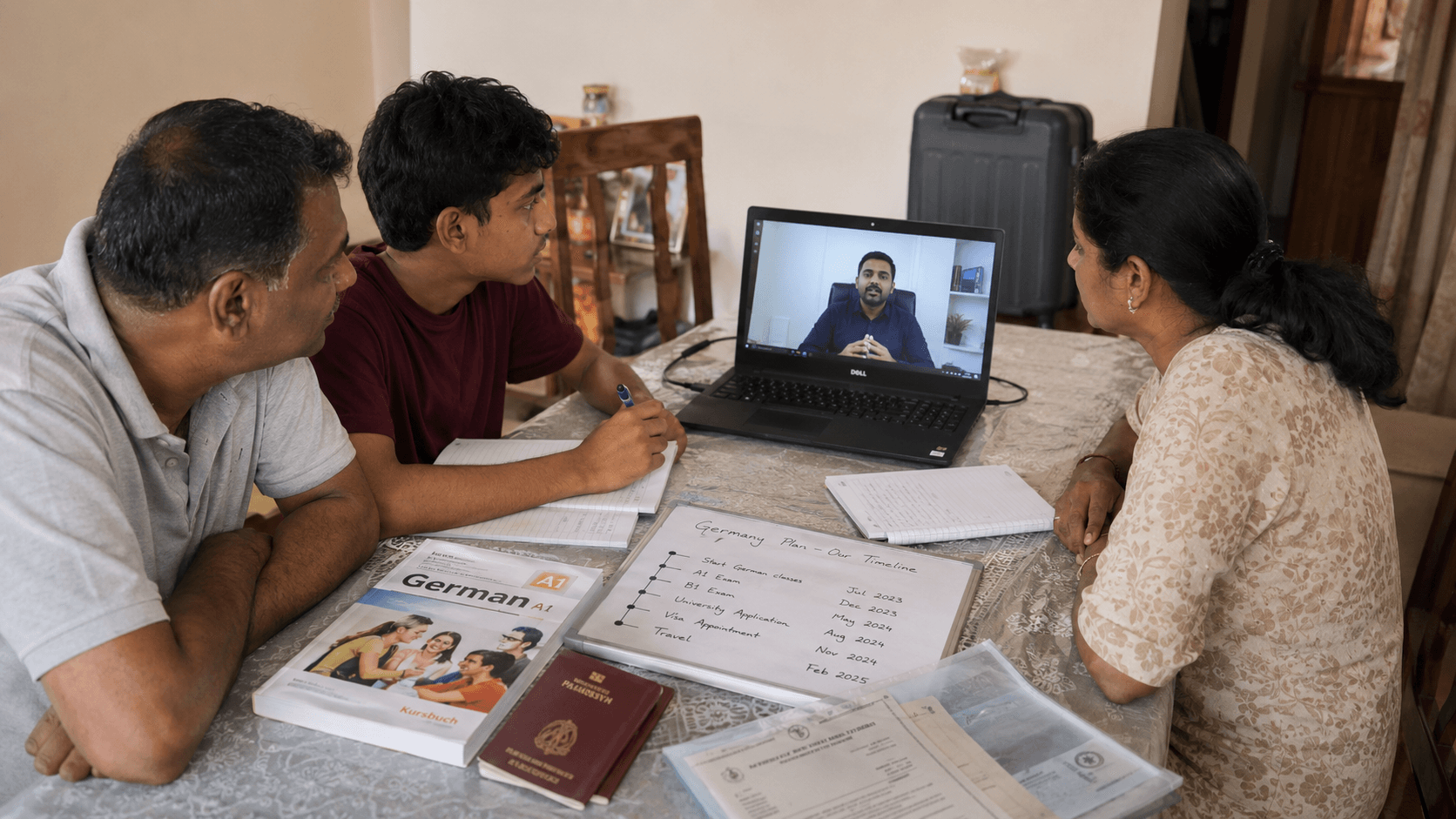
Start German language training immediately. Every pathway to Germany requires German. Even the Chancenkarte, where A1 technically qualifies you, requires B2 to find work within 12 months. Starting A1 courses while you research pathways means you are making progress in parallel, not sequentially. MALIROSA offers A1 to B2 online courses taught by certified instructors and aligned with Goethe-Institut exam formats. See German course options.
Confirm your pathway based on your profile. Ausbildung: under 35, completed secondary education, no degree, or with a degree but seeking a practical training route. Skilled Worker Visa: degree or professional qualification that Germany recognises, job offer secured. Chancenkarte: degree plus 6+ Chancenkarte points and ability to sustain yourself for 12 months. Student Visa: university admission letter in hand.
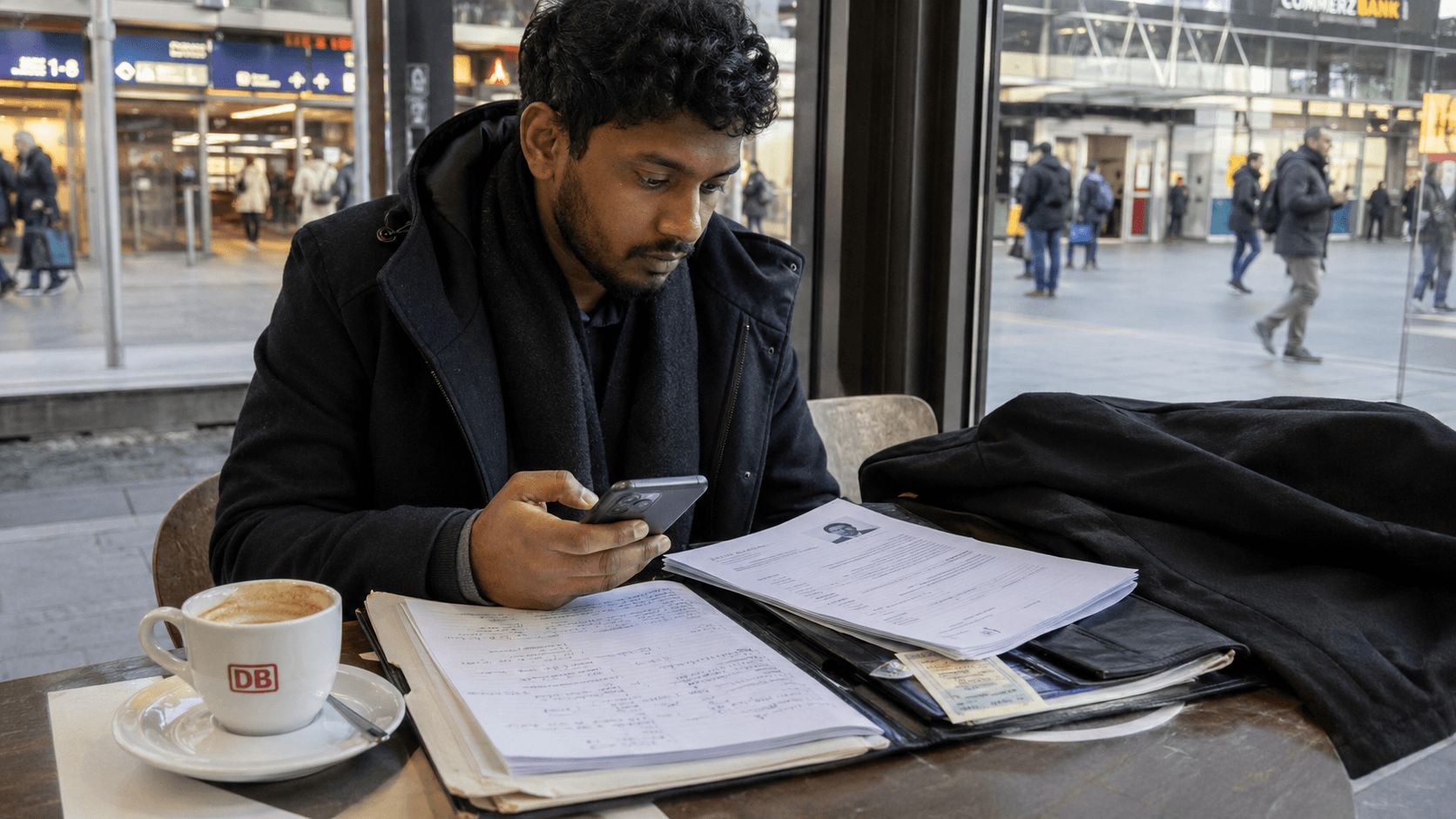
Gather and certify your documents. Most pathways require: valid passport (18+ months validity beyond intended stay), birth certificate with certified German translation, educational certificates with certified German translation, police clearance certificate (apostilled by the Sri Lankan Ministry of Foreign Affairs), and a German language certificate from Goethe-Institut, ÖSD, or telc. Allow 4–8 weeks for apostilles and certified translations.
Book your visa appointment at VFS Global Colombo. The German Embassy in Colombo has authorised VFS Global as its processing centre. Book at visa.vfsglobal.com (Germany section). Appointment slots fill 4–8 weeks in advance during peak periods (March–August). Book as soon as your documents are near-complete, not after.
Prepare financially for Germany. Requirements vary by pathway: Ausbildung visa candidates need evidence of accommodation and health insurance; the training salary covers living costs from day one. Chancenkarte applicants need a Sperrkonto (blocked account) with €13,092. Student visa applicants need €11,208. Plan these requirements at the start of your preparation, not at the end.
Submit your complete application and wait for processing. The German Embassy in Colombo processes Ausbildung visas in 6–12 weeks from a complete submission. The application fee is €75, payable in LKR at the prevailing exchange rate at your appointment. Do not submit an incomplete file; rejections are documented and may affect future applications.
Sri Lanka-Specific Document Requirements You Cannot Afford to Get Wrong
Document errors are the single most common cause of visa delays for Sri Lankan applicants. These requirements are specific to Sri Lanka and are not always clear on general Germany visa resources.
Police Clearance Certificate: obtain from Sri Lanka Police headquarters in Colombo. Must be apostilled by the Ministry of Foreign Affairs, Sri Lanka. The apostille process takes 3–7 business days. The clearance must be less than 3 months old at the time of your visa appointment.
Educational Certificates: O/L and A/L certificates, or university degrees, must be accompanied by a certified German translation if the originals are in Sinhala or Tamil. Use a sworn translator (vereidigter Übersetzer) on the German Embassy Colombo's approved list; self-translations and agency translations without a sworn declaration are not accepted.
Birth Certificate: must include certified German translation if in Sinhala or Tamil. If your birth certificate is a "short form" extract, the embassy may require the full register entry.
Name consistency: a discrepancy in name spelling between your passport, birth certificate, and educational certificates will put an application on hold. Check this before booking your appointment.
Ausbildungsvertrag (training contract): if applicable, must be signed by both parties, specify the training occupation using the official BIBB Beruf title, the training location, start and end dates, and the monthly training salary.
3 Costly Mistakes Sri Lankan Candidates Make
Understanding what goes wrong is as important as understanding what to do right. These three mistakes account for the majority of preventable delays and refusals.
Underestimating the German language requirement. Many candidates assume A2 or "some German" is enough to start applying. It is not. Ausbildung training environments operate entirely in German; vocational school exams, team briefings, safety instructions, and performance reviews are all in German. B1 is the practical minimum for the visa; B2 is what employers actually want. The BIBB reported in 2023 that fewer than 1 in 5 international Ausbildung applicants met language expectations at application stage.
Leaving document preparation too late. Educational certificates, police clearances, apostilles, and certified translations from Sri Lanka take 4–8 weeks minimum. Treating this as the final step regularly means missing visa appointment windows and rescheduling by months. Start document collection at the same time as your language training.
Paying unverified agents who promise specific outcomes. No agent or consultant can guarantee a German visa; visa decisions are made exclusively by the German Embassy or relevant German authority. Work only with consultants who are transparent about what they can and cannot do, who explain the process in full, and who publish their fee structure upfront. MALIROSA publishes its fee structure clearly and does not charge success fees tied to visa outcomes.
Why MALIROSA Understands Both Sides of This Journey
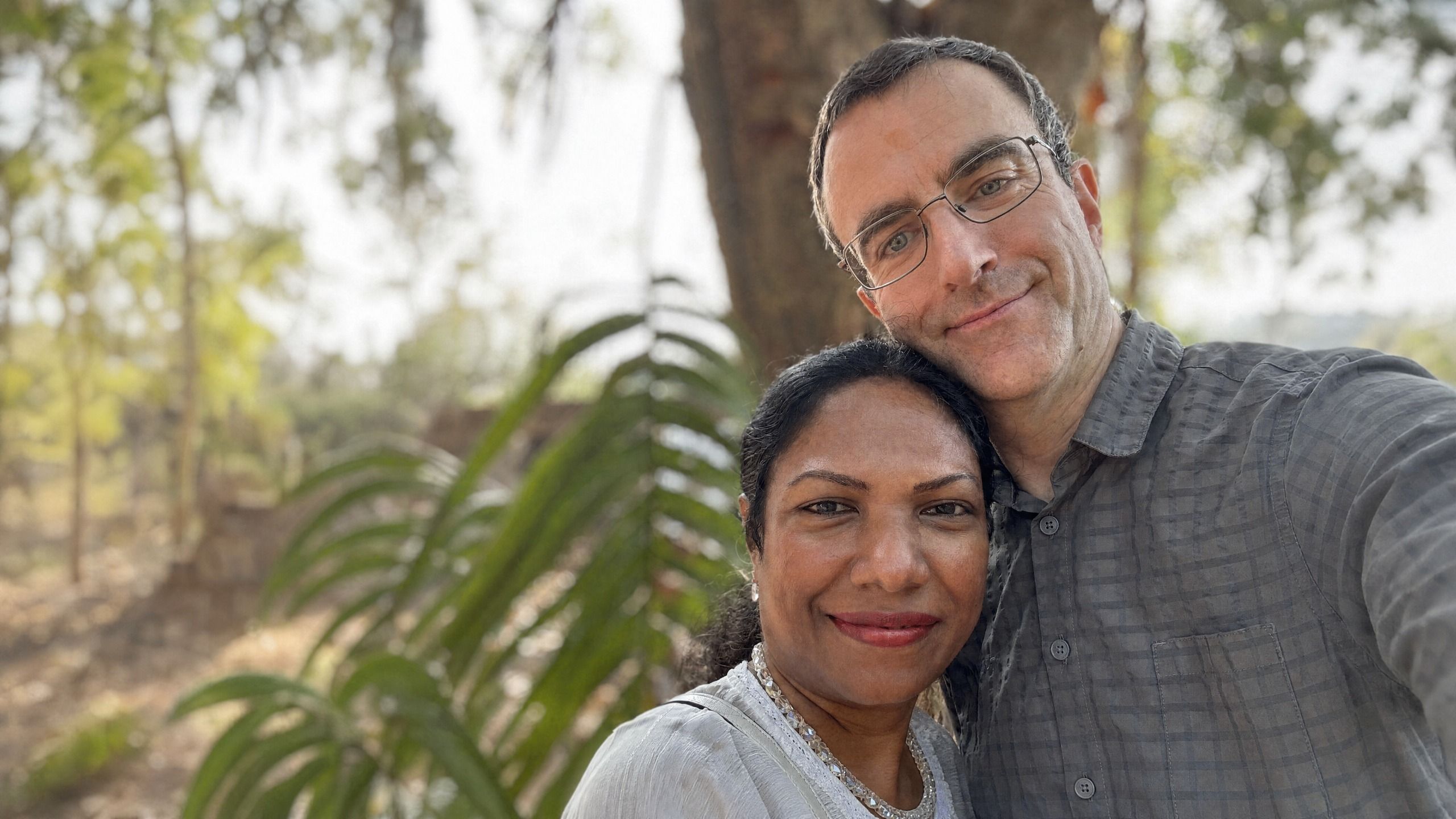
MALIROSA was founded by a German-Sri Lankan couple who understand both worlds from the inside. Robert Saiger is based in Konstanz, Germany, with a background in Industrial Engineering and Management and direct experience with German employers, institutions, and the German immigration system. Randima Saiger brings personal understanding of the Sri Lankan context: the education system, the family pressures, and the genuine aspirations of young Sri Lankans who want to build a future abroad.
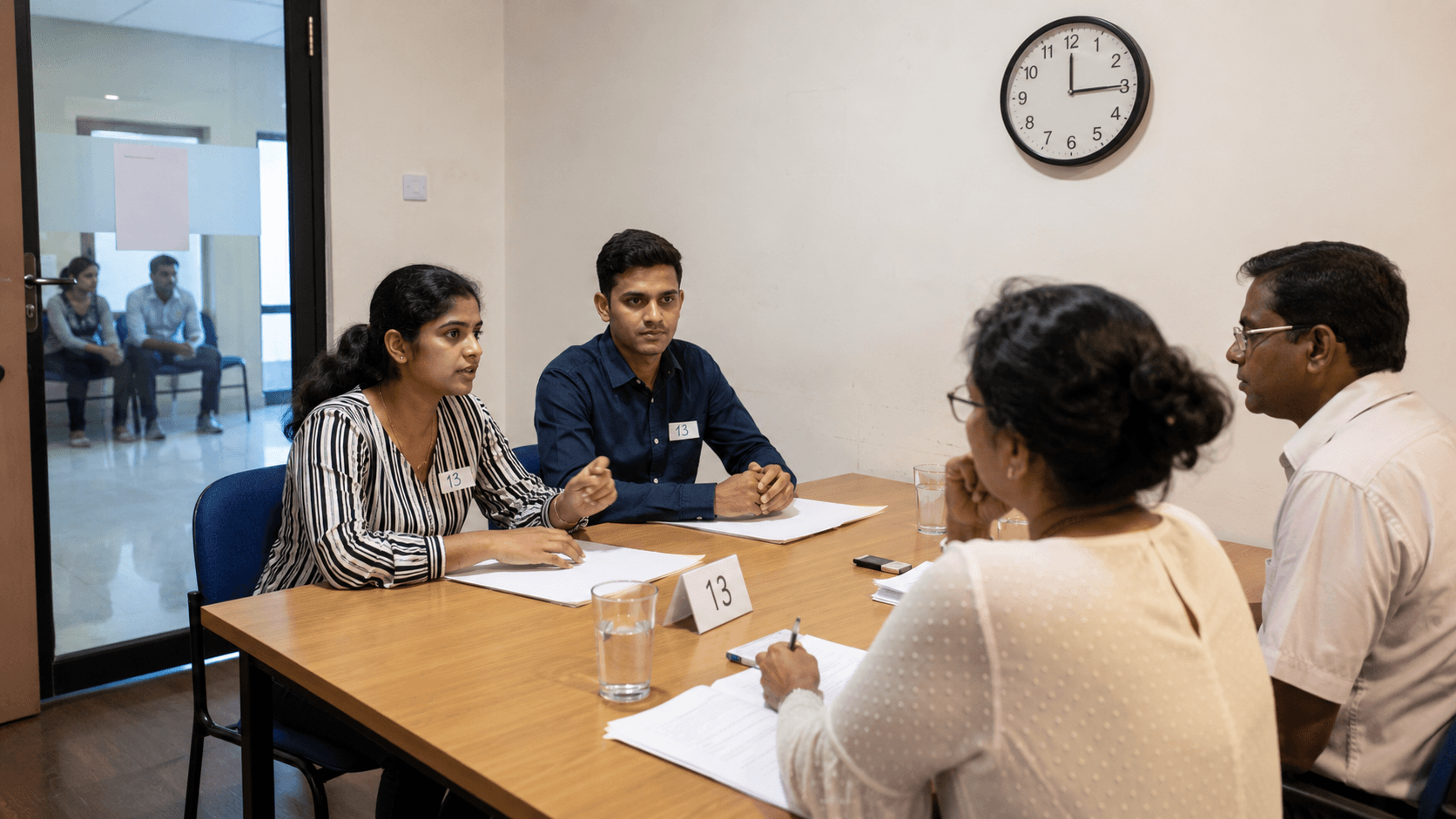
That dual perspective is why MALIROSA guidance is both technically correct and personally honest. We know what German employers actually ask international Ausbildung candidates at interview. We know what the German Embassy in Colombo checks line by line. We know the difference between a realistic pathway and a false promise, and we will always tell you which one you are looking at.
MALIROSA's fee structure is published upfront. Refund conditions are clear. We do not chase placements or collect fees tied to outcomes we cannot control. Our measure of success is candidates who actually reach Germany and complete their training. Read about the MALIROSA approach.
Continue Your Journey
Get structured guidance on every Germany visa pathway.
Robert Saiger is a co-founder of MALIROSA with a background in Industrial Engineering & Management and Certified Consultant & Coach. Based in Konstanz, Germany, he brings direct expertise in Germany visa pathways, employer expectations, and the Sri Lankan qualification system.
Can I move to Germany from Sri Lanka without knowing any German?
You can begin preparing without German by enrolling in A1 classes and starting to plan your pathway. But you cannot complete a visa application for Ausbildung, skilled work, or the Chancenkarte without reaching at least B1. The Language Course Visa (§16f AufenthG) lets you study German in Germany itself, which some candidates choose as their first step if they can fund 3–6 months of living costs plus a language course fee.
How long does it take to move to Germany from Sri Lanka?
For the Ausbildung route starting from zero German, the realistic timeline is 18–24 months: approximately 12–14 months to reach B1/B2, 2–4 months for employer matching and contract signing, and 4–6 months for document preparation and embassy processing. Candidates who already hold B2 German and a recognised qualification can sometimes reach Germany in 6–9 months via the Skilled Worker Visa or Chancenkarte.
How much does it cost to move to Germany from Sri Lanka?
Key preparation costs: German language course (MALIROSA's A1–B2 pathway is transparently priced), visa application fee of €75 (payable in LKR), document apostille fees of LKR 5,000–15,000 per document, and certified German translation at approximately LKR 3,000–8,000 per page. The Chancenkarte requires a Sperrkonto of €13,092. Ausbildung pays you from day one (€724–1,300/month depending on sector and year), so ongoing living costs are covered once you begin training.
Does MALIROSA guarantee I will get a visa?
No. Visa decisions are made exclusively by the German Embassy or the responsible German authority (Ausländerbehörde). MALIROSA supports your preparation, documentation, and application strategy; we cannot influence the embassy's decision. Any consultant who claims to guarantee a German visa is not being honest with you. Our role is to ensure your application is complete, correct, and as strong as it can be.
Can Sri Lankan candidates get permanent residency in Germany?
Yes. Germany's Niederlassungserlaubnis (permanent residency) is available after five years of continuous legal residence in Germany. For Ausbildung graduates who work two years in their trained field after completing training, the timeline is shorter; §18b AufenthG provides a settlement permit pathway after just two years of skilled employment following Ausbildung completion. Requirements include adequate German (B1 minimum), financial self-sufficiency, and a clean record.
What sectors have the most Ausbildung opportunities for Sri Lankan candidates?
The sectors with the highest unmet demand and most accessible pathways for international candidates are: nursing and elderly care (Germany faces a projected shortage of 500,000 healthcare workers by 2030, Source: Bertelsmann Stiftung, 2023), hospitality and gastronomy, logistics and warehousing, retail and business administration, and electrical/mechanical trades. MALIROSA matches candidates to sectors that fit their profile and language level.
Do I need a job offer before applying for a German visa from Sri Lanka?
It depends on the pathway. The Ausbildung visa requires a signed Ausbildungsvertrag (training contract). The Skilled Worker Visa requires a confirmed job offer. The Chancenkarte is the exception; it specifically allows you to enter Germany without a job offer and search in person. The Student Visa requires a university admission letter. The Language Course Visa requires enrolment at a recognised German language school.
Which German language certificate does the German Embassy accept?
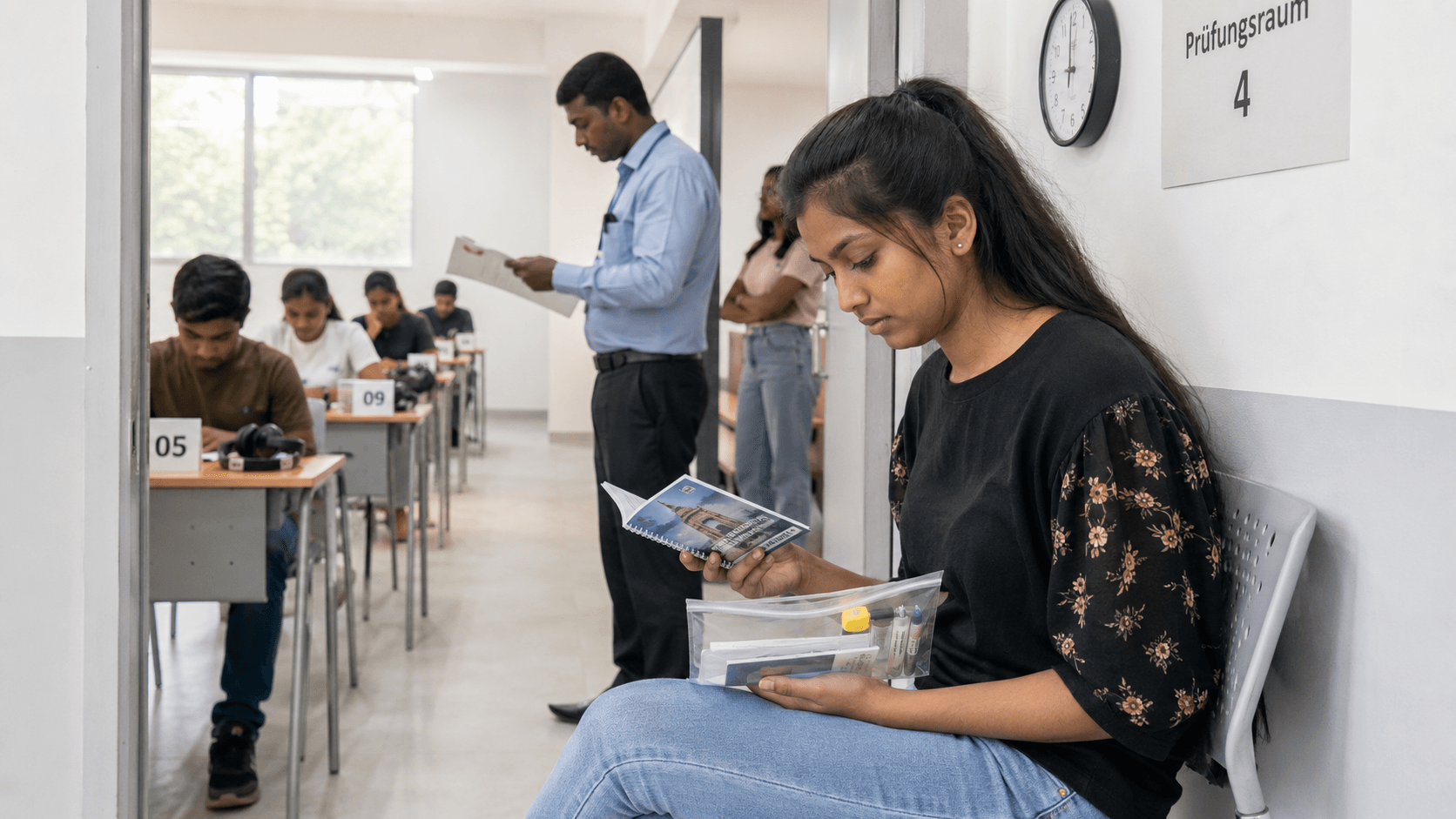
Accepted certificates for German visa applications include: Goethe-Zertifikat (any level), ÖSD Zertifikat, telc Deutsch, and DSH (for university applications). Online course certificates, in-house school certificates, and informal assessments are not accepted. The Goethe-Institut Sri Lanka (goethe.de/ins/lk/en) in Colombo conducts official examinations at A1 through C2. Book exam slots well in advance; they fill 6–8 weeks out.
Your Pathway to Germany Starts With One Honest Conversation
Reading a guide tells you what is possible. Talking to someone who has helped Sri Lankan candidates through this process tells you what is realistic for your specific profile. Submit your details through the MALIROSA registration form and our team will review your background, education, German level, work experience, and timeline, and send you an honest assessment of which pathway fits you and what your next step is. No sales pitch. No obligation. Just a clear-eyed look at where you stand.
How to Apply for an Ausbildung Visa from Sri Lanka (2026 Step-by-Step Guide)
Most Sri Lankan Ausbildung visa applications are rejected not because candidates lack a training contract, but because their documents are incomplete or incorrectly certified. This step-by-step guide shows you exactly what the German Embassy in Colombo requires and how to avoid the errors that delay most applications by six months.
German Motivation Letter for Ausbildung: What to Write and What Loses You the Place
Most Ausbildung applications fail before anyone reads the CV. The Motivationsschreiben is the first thing a German training company reads, and most international candidates get it completely wrong. Here is what actually works, including a real example.
10 min read
Our Story
Two Worlds, One Purpose: The Story Behind MALIROSA
MALIROSA grew from a decade of living the exact journey that our candidates are about to begin: between Sri Lanka and Germany, between two cultures, two languages, and two very different sets of expectations.
5 min read
Ausbildung
How to Find an Ausbildung Employer in Germany from Sri Lanka (2026 Guide)
You cannot show up in Germany and then find an Ausbildung employer. You need a signed training contract before your visa is approved. This guide covers every active portal, how to write applications German employers actually read, and the realistic timeline from first search to visa approval.
11 min read
German Language
How to Pass the German B2 Exam from Sri Lanka: Goethe B2 vs OSD B2 Compared
B2 is the gateway to university admission in Germany, most skilled worker visas, and healthcare and IT Ausbildung contracts. If you are preparing from Sri Lanka, this guide covers exactly what B2 requires, how the Goethe B2 and OSD B2 compare in Sri Lanka, exam fees, registration, and a realistic preparation timeline from B1 to pass.