How to Apply for an Ausbildung Visa from Sri Lanka (2026) | Malirosa Pvt Ltd
Share
Ausbildung
12 min read
How to Apply for an Ausbildung Visa from Sri Lanka (2026 Step-by-Step Guide)
Most Sri Lankan Ausbildung visa applications are rejected not because candidates lack a training contract, but because their documents are incomplete or incorrectly certified. This step-by-step guide shows you exactly what the German Embassy in Colombo requires and how to avoid the errors that delay most applications by six months.
Every year, Sri Lankan candidates with signed German training contracts and genuine qualifications are rejected at the German Embassy in Colombo. The reason is almost never the application itself. It is the file. A missing apostille on a police clearance. A self-translated birth certificate. A name spelling that differs by one letter between the passport and the educational certificate.
Germany's Ausbildung visa (formally the Visum zur Berufsausbildung, §16a AufenthG) is one of the most structured and clearly defined visa categories in the German Residence Act. The requirements are published, the process is sequential, and the outcome is predictable when the preparation is correct.
For Sri Lankan candidates, the Ausbildung pathway is one of the most realistic routes to a life in Germany. You receive a salary from day one, gain a state-recognised German qualification after two to three years, and have a clear legal path to permanent residency. This guide covers every step, from securing a training place to collecting your visa, so you avoid the mistakes that delay most applications.
What the Ausbildung Visa Is and What It Entitles You To
The Ausbildung visa is issued under §16a of the German Residence Act (Aufenthaltsgesetz, AufenthG). It permits a third-country national, including Sri Lankan passport holders, to enter Germany and complete a state-recognised vocational training programme (anerkannte Berufsausbildung). (Source: Aufenthaltsgesetz §16a, Federal Ministry of Justice, bundesjustizamt.de, 2024)
The visa is issued for the full duration of the training contract, typically two to three years. During this period you are entitled to: reside legally in Germany, work at your training company (four to five days per week), attend vocational school (Berufsschule, one to two days per week), and receive a legally guaranteed minimum training salary. In 2026, that minimum is €724/month in year one, rising to at least €837/month by year three. (Source: Federal Institute for Vocational Education and Training / BIBB, 2026)
After completing your Ausbildung: you receive an 18-month job-seeking permit (Aufenthaltserlaubnis zur Arbeitsuche). After working in your trained field for two subsequent years, you become eligible for permanent residency (Niederlassungserlaubnis) under §18b AufenthG, one of the most direct PR routes available to non-EU nationals. (Source: Aufenthaltsgesetz §18b, 2024)
The Ausbildung visa covers more than 325 state-recognised professions across healthcare, hospitality, logistics, retail, IT, and technical trades. (Source: BIBB, 2026). The most in-demand sectors for Sri Lankan candidates are nursing and elderly care (Pflegefachkraft), hotel and restaurant management (Hotelfachmann/Hotelfachfrau), electrical installation (Elektroniker), and retail business (Kaufmann/Kauffrau im Einzelhandel).
What You Need in Place Before the Visa Application Begins
The Ausbildung visa application cannot begin without two things already in place. These are not documents you collect at the end; they are the foundation on which the entire application rests. Without both, the German Embassy in Colombo will not process your file.
A signed Ausbildungsvertrag (training contract) from a German employer. The contract must name the training occupation using its official BIBB Berufstitel (e.g., Pflegefachfrau, Hotelfachmann), state the training company name and address, specify the start and end dates of the training, confirm the monthly training salary for each year, and be signed by both the trainee and an authorised representative of the company.
A German language certificate at B1 level or higher. Accepted institutions: Goethe-Institut (Goethe-Zertifikat B1), ÖSD (ÖSD Zertifikat B1), or telc (telc Deutsch B1). The Goethe-Institut Sri Lanka (goethe.de/ins/lk/en) in Colombo conducts official examinations. IELTS and TOEFL are not accepted for the Ausbildung visa.
A valid Sri Lankan passport with at least 12 months of validity beyond the planned training start date and at least 2 blank pages.
Proof of completed secondary education: O/L and A/L certificates, or a university degree if applicable. Documents in Sinhala or Tamil require certified German translation.
Confirmed accommodation in Germany: employer-provided housing confirmation, a signed rental agreement, or a written invitation from a host in Germany stating the address. A hotel booking alone is insufficient.
Valid health insurance cover for Germany from the date of entry. German public health insurance (GKV) is compulsory from the first day of training; your training company can advise on enrolment with TK, AOK, or Barmer before departure.
The 9-Step Ausbildung Visa Application Process for Sri Lankan Candidates
The process below applies specifically to Sri Lankan nationals applying through the German Embassy in Colombo, which processes applications via VFS Global. The steps are sequential; completing them out of order adds delays and, in some cases, requires restarting stages.
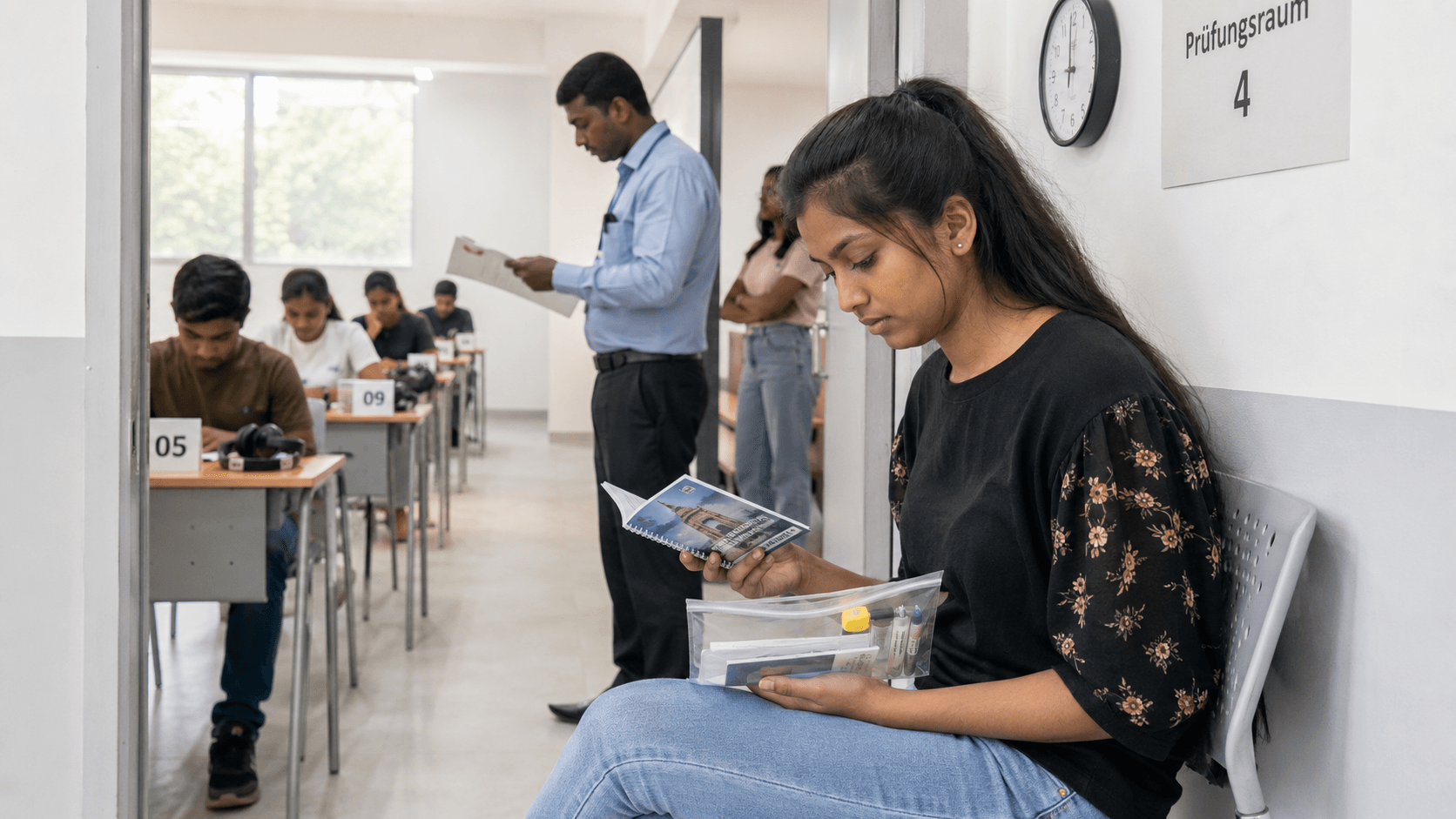
Reach B1 German level and sit your official examination. The Goethe-Institut Sri Lanka in Colombo conducts B1 examinations on a scheduled calendar; check goethe.de/ins/lk/en for the next available dates. Exam registration closes 4–6 weeks before the sitting date. Allow time to receive your physical certificate after passing (typically 4–6 weeks post-exam).
Identify target Ausbildung sectors and apply to German employers. Sectors with the highest demand for international candidates: nursing and elderly care, hospitality and gastronomy, logistics and warehousing, and technical trades. Direct applications to German employers are possible through platforms like Ausbildung.de, Make-it-in-Germany.com (the official German government portal at make-it-in-germany.com), and the Bundesagentur für Arbeit job portal (arbeitsagentur.de). MALIROSA provides employer search support and CV coaching as part of our Ausbildung preparation service.
Receive, review, and sign your Ausbildungsvertrag. Read the contract carefully: confirm the exact Berufstitel, the training location, the start date, and the salary figures for each training year. The training company registers the signed contract with the relevant Chamber (IHK or HWK); you do not need to do this yourself, but confirm it has been done before proceeding.
Arrange confirmed accommodation in Germany. Options: employer-provided housing (many training companies, particularly in nursing and hospitality, offer subsidised accommodation), a rental agreement from a private landlord, or a confirmed invitation from a German-resident host with their full address. Accommodation in Germany is one of the hardest practical elements for Sri Lankan candidates; address it early, not after the visa appointment is booked.
Enrol in German public health insurance (GKV). Contact TK (tk.de), AOK, or Barmer before departure. Provide your Ausbildungsvertrag as proof of upcoming employment. They will issue a Mitgliedschaftsbescheinigung (health insurance membership certificate); this is what you submit with your visa application.
Collect and certify all supporting documents. See the complete checklist in the next section. Allow 4–8 weeks for this phase; apostilles from the Ministry of Foreign Affairs Sri Lanka, certified German translations, and police clearances all have processing times that cannot be shortened by showing up in person.
Book your visa appointment at VFS Global Colombo. The German Embassy has authorised VFS Global as its visa processing centre. Book at visa.vfsglobal.com (Germany / Sri Lanka). Book as early as possible; slots in peak periods (March–August) fill 6–8 weeks in advance. You can book your appointment before all documents are finalised, then use the waiting period to complete remaining preparation. Application fee: €75, payable in LKR at the prevailing exchange rate on the appointment date. (Source: German Embassy fee schedule, colombo.diplo.de, 2024)
Submit your complete application at your VFS appointment. Arrive with two collated, complete sets of all documents. Biometric data (fingerprints and photograph) is collected at this appointment. Do not submit an incomplete file; incomplete applications are returned without processing, the fee is not refunded, and you must rebook. (Source: German Embassy Colombo, 2024)
Wait for the processing decision. The Ausbildung visa (§16a AufenthG) currently takes 6–12 weeks to process from the date of a complete, accepted submission at the German Embassy Colombo. You cannot speed this up. Use the waiting period to continue German study; most candidates arrive in Germany with B1 and the vocational school environment accelerates progress to B2 within the first year of training. (Source: German Embassy Colombo, colombo.diplo.de, 2024)
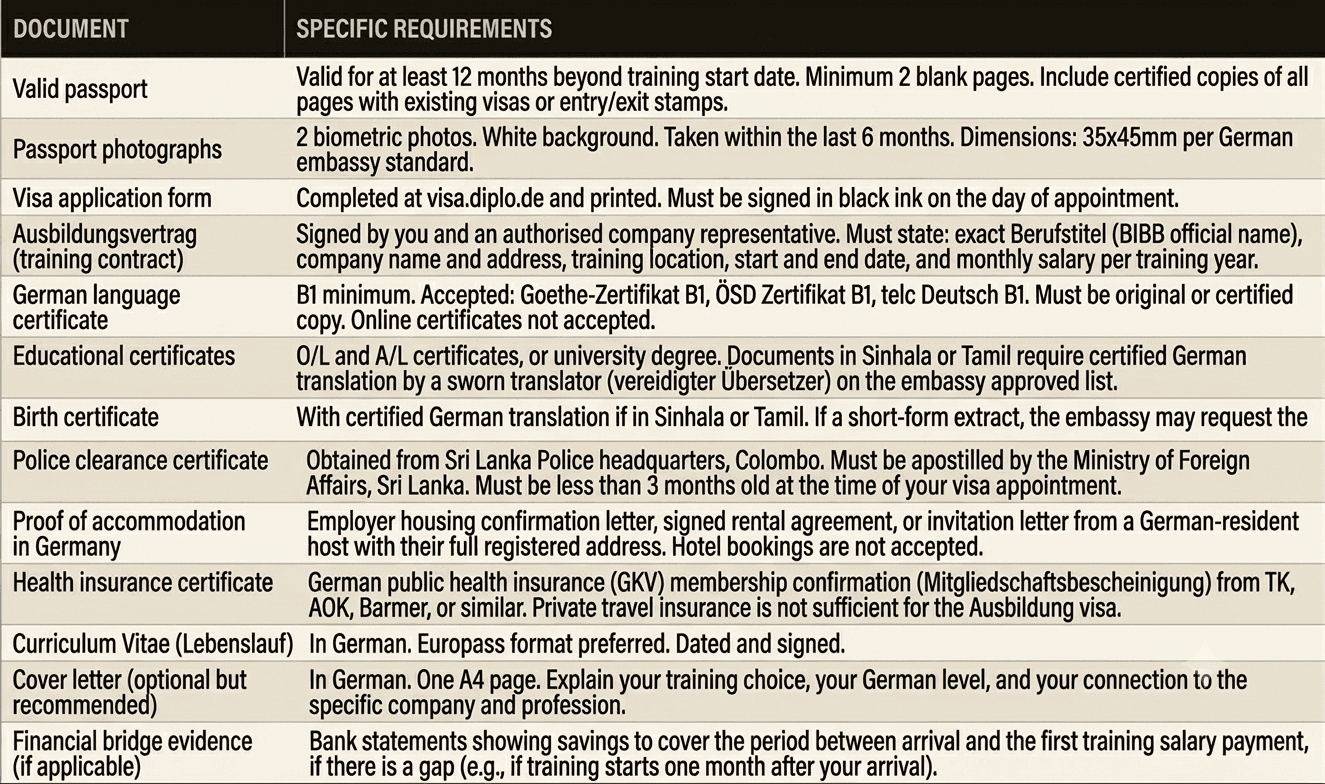
Complete Documents Checklist for the Ausbildung Visa (German Embassy Colombo)
The following list reflects standard requirements of the German Embassy in Colombo. Requirements do change; always verify the current list on colombo.diplo.de before your appointment. Prepare two complete, collated sets: VFS retains one, returns the other.
The B1 Language Requirement: Why It Is Non-Negotiable and What Employers Actually Need
The B1 German language requirement for the Ausbildung visa is not arbitrary; it is set at B1 because that is the minimum level at which a candidate can functionally participate in the vocational school curriculum. German Berufsschulen (vocational schools) teach entirely in German. The theoretical component of your Ausbildung, one to two days per week, involves written exams, class participation, and practical assignments, all in German. A candidate below B1 cannot pass these examinations.
On the practical side, your training company needs you to understand team briefings, safety instructions, customer interactions, and performance feedback from day one. The BIBB reported in 2023 that fewer than 1 in 5 international Ausbildung applicants met language expectations at application stage; this is the single biggest filter in employer selection. (Source: BIBB Datenreport, 2023)
B2 changes the picture substantially. At B2, you can follow nuanced professional communication, write reports in your field, handle customer complaints, and engage naturally in team discussions. Most healthcare and hospitality employers require B2 as a practical minimum; the B1 requirement is for the visa, not for the employer. Candidates who apply with B2 certificates secure better-quality training contracts in better-quality companies.
MALIROSA structures language preparation around both thresholds. Our German language courses A1–B2 are aligned with Goethe-Institut examination formats and taught by certified instructors. The realistic timeline from zero to B1 is 10–14 months with 10–15 hours of structured study per week. The additional push to B2 takes 4–6 more months.
Accepted language certificates for the Ausbildung visa: Goethe-Zertifikat B1, ÖSD Zertifikat B1, telc Deutsch B1, or DSH (for university pathways). The Goethe-Institut Sri Lanka (goethe.de/ins/lk/en) in Colombo conducts official examinations. IELTS and TOEFL are not accepted for this visa category.
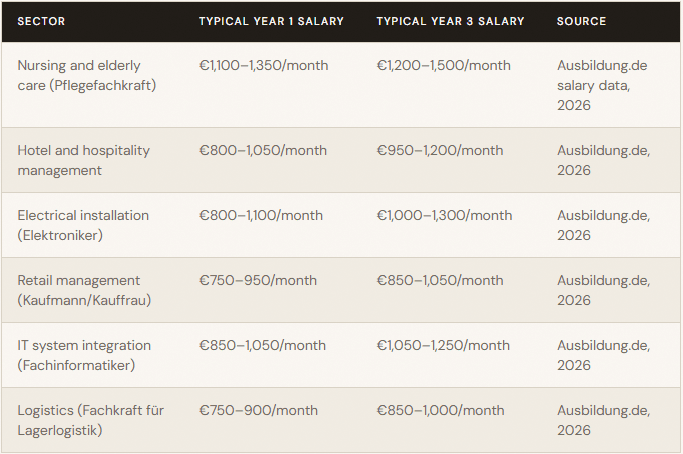
Ausbildung Salary in Germany: What Sri Lankan Candidates Actually Earn
One of the most common questions from Sri Lankan candidates is what the Ausbildung actually pays. The answer depends on the sector and the individual training company, but there is a legally guaranteed minimum across all professions.
Since 2020, Germany's Berufsbildungsgesetz (Vocational Training Act) has set statutory minimum training salaries. For 2026, these are: Year 1: €724/month, Year 2: €766/month, Year 3: €837/month. Most training companies pay above these minimums, particularly in sectors with the most competition for candidates. (Source: BIBB, 2026)
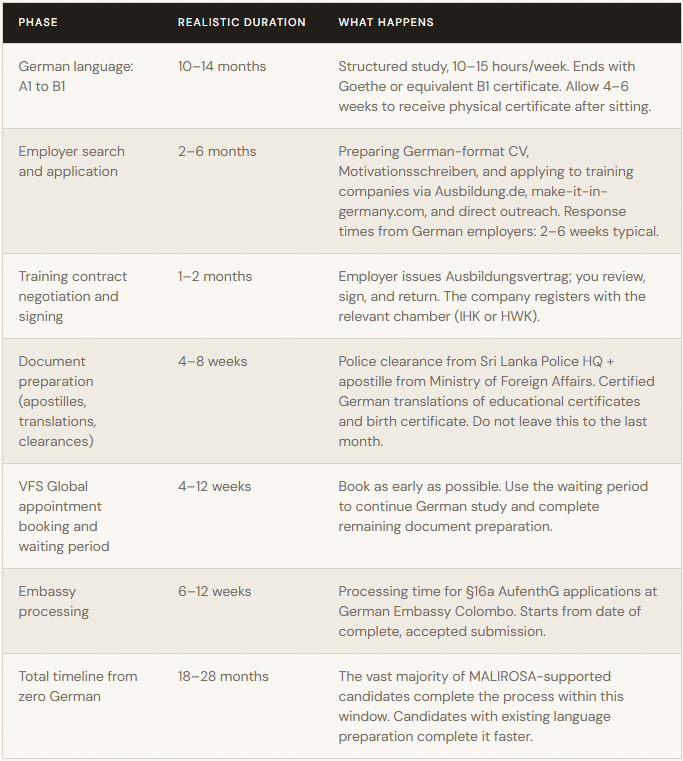
Realistic Timeline: From Sri Lanka to Germany on the Ausbildung Route
Most candidates who start from scratch (no German, no employer contact yet) take 18–24 months to complete the full process. Candidates who already hold a B1 certificate and are actively applying to German employers typically secure a training place and visa within 6–12 months. The biggest variable is language.
The Document Errors That Delay Most Sri Lankan Ausbildung Visa Applications
Based on the patterns MALIROSA observes in Sri Lankan candidate applications, these errors account for the majority of preventable delays and refusals. Each one is avoidable with proper preparation.
Missing or incorrectly certified translations. Any document not in German or English must be translated into German by a sworn translator (vereidigter Übersetzer) recognised by a German court. Use only translators from the German Embassy Colombo's approved list. Self-translations, Google Translate outputs, and translations from uncertified agencies are all rejected. (Source: German Embassy Colombo documentation requirements, 2024)
Name discrepancies across documents. A single-letter spelling difference between your passport, birth certificate, and educational certificates will put your application on hold. The German Embassy checks name consistency across every document in the file. Check this before you book your appointment.
Expired police clearance certificate. Police clearances must be less than three months old at the time of your VFS appointment. If your appointment is 8 weeks away and your clearance is already 6 weeks old, you will need a fresh one. Factor this into your timeline.
Language certificate below B1. Applications submitted with A2 certificates or informal language proof are refused at the application stage. There is no discretionary consideration below B1.
Incomplete training contract. The Ausbildungsvertrag must specify the exact Berufstitel as listed in BIBB's official register, the training company's full address, start and end dates, monthly salary for each training year, and dual signatures. Missing any of these makes the contract legally insufficient for visa purposes.
No confirmed accommodation. A hotel booking is not accepted as proof of accommodation. The embassy requires a confirmed address in Germany: employer housing, a signed rental agreement, or a written host invitation with the host's full registered address.
Apostille missing on police clearance. The Sri Lanka Police clearance certificate must be separately apostilled by the Ministry of Foreign Affairs, Sri Lanka. The police stamp alone is not sufficient for a German visa application.
Submitting an incomplete file at the VFS appointment. Incomplete applications are returned, the €75 fee is not refunded, and you must rebook and wait for a new appointment slot. MALIROSA strongly recommends having a complete file review by a qualified consultant, not just a friend, before attending your appointment.
How MALIROSA Prepares Sri Lankan Candidates for the Ausbildung Visa
MALIROSA was built specifically for this journey, not just the visa application, but the full pathway from language study to life in Germany. We work with Sri Lankan candidates through each stage: language preparation, employer search support, CV and Motivationsschreiben coaching, document review, and pre-departure orientation.
Robert Saiger brings direct experience of German training companies: what they look for in international candidates, what concerns them about long-distance hiring, and what distinguishes a credible application from the hundreds of weak ones they receive. Randima Saiger brings understanding of where Sri Lankan candidates typically need the most practical support: bridging the communication style gap between Sri Lankan professional norms and German employer expectations.
Our Ausbildung preparation service does not process your visa for you; visa decisions are made exclusively by the German Embassy or responsible German authority, and MALIROSA cannot influence those decisions. What we do is ensure that when you walk into your VFS appointment, your file is complete, correct, and as strong as it can be. That is the part we control.
Continue Your Journey
Full Ausbildung preparation from language to visa.
Robert Saiger is a co-founder of MALIROSA with a background in Industrial Engineering & Management and Certified Consultant & Coach. Based in Konstanz, Germany, he brings direct expertise in Germany visa pathways, employer expectations, and the Sri Lankan qualification system.
Can I apply for an Ausbildung visa without a confirmed training contract?
No. The Ausbildungsvertrag (training contract) is the core document of the Ausbildung visa application. Without a signed contract from a German employer, the visa cannot be issued. The German Embassy in Colombo will not process an application based on a job offer letter, a letter of intent, or a verbal agreement. The contract must be signed, stamped, and registered with the relevant IHK or HWK before your application.
Which German language certificate is accepted for the Ausbildung visa?
Accepted certificates at B1 level: Goethe-Zertifikat B1, ÖSD Zertifikat B1, and telc Deutsch B1. The Goethe-Institut Sri Lanka in Colombo conducts official examinations. Informal assessments, in-house school certificates, and online course completion certificates are not accepted. Your certificate must be original or a certified copy.
How long does the Ausbildung visa take to process from German Embassy Colombo?
The Ausbildung visa (§16a AufenthG) takes 6–12 weeks to process from the date of a complete, accepted submission at the German Embassy Colombo. This is processing time only; add 4–12 weeks for the VFS appointment wait. Most candidates should plan a minimum 6-month lead time from the date of their VFS appointment booking to their planned departure date. (Source: German Embassy Colombo, colombo.diplo.de, 2024)
Does the Ausbildung visa lead to permanent residency in Germany?
Yes. After completing your Ausbildung and subsequently working in your trained occupation for two years in Germany, you become eligible to apply for a settlement permit (Niederlassungserlaubnis, or permanent residency) under §18b AufenthG. This is one of the most direct routes to permanent residency available to non-EU nationals, significantly shorter than the standard five-year legal residence requirement. (Source: Aufenthaltsgesetz §18b, 2024)
How much does the Ausbildung pay in Germany?
Germany's Berufsbildungsgesetz guarantees a minimum training salary in 2026 of €724/month in year one, €766/month in year two, and €837/month in year three. Most sectors pay above this minimum. Nursing apprentices typically earn €1,100–1,350/month in year one. Hotel and hospitality apprentices earn €800–1,050/month. IT system integration apprentices earn €850–1,050/month. (Source: BIBB, Ausbildung.de, 2026)
Can MALIROSA find me an Ausbildung training place in Germany?
MALIROSA provides employer search support, CV coaching, Motivationsschreiben preparation, and interview coaching as part of our Ausbildung preparation service. We do not guarantee placement with a specific employer; employer hiring decisions are made by the companies themselves. MALIROSA's role is to ensure your application documents and language preparation are at the standard German employers expect, which substantially improves your chances of securing a contract.
Do I need health insurance before applying for the Ausbildung visa?
Yes. You must provide proof of German public health insurance (GKV) membership as part of your visa application. Contact a German public insurer such as TK (Techniker Krankenkasse), AOK, or Barmer before your VFS appointment; they can issue a membership confirmation letter once you provide your signed Ausbildungsvertrag as proof of upcoming employment. Private international travel insurance is not accepted for the Ausbildung visa.
Can I bring my family to Germany on the Ausbildung visa?
Family reunification during Ausbildung is possible under §30 and §32 AufenthG but requires proof of sufficient living space and financial means beyond the training salary. In practice, most Ausbildung trainees find it more practical to arrange family reunification after completing training and securing permanent employment, when income is higher and the residency situation is more stable.
Start Your Ausbildung Preparation with a Free Profile Review
The Ausbildung route is one of the most realistic pathways to a life in Germany for Sri Lankan candidates, but the preparation has to be right. Submit your profile to MALIROSA. Robert will review your educational background, current German level, and target sector and send you back a clear assessment: which Ausbildung professions fit your profile, what language preparation you still need, and what your realistic timeline looks like. No obligation, no sales pitch, just a straight answer.
German Motivation Letter for Ausbildung: What to Write and What Loses You the Place
Most Ausbildung applications fail before anyone reads the CV. The Motivationsschreiben is the first thing a German training company reads, and most international candidates get it completely wrong. Here is what actually works, including a real example.
Two Worlds, One Purpose: The Story Behind MALIROSA
MALIROSA grew from a decade of living the exact journey that our candidates are about to begin: between Sri Lanka and Germany, between two cultures, two languages, and two very different sets of expectations.
5 min read
Visa & Pathways
Family Reunion Visa Germany: Who Can Apply, What Is Required, and How Long It Takes
Germany granted over 100,000 family reunion visas in 2023. Most applicants wait between three and twelve months for an appointment at the German Embassy. Understanding the requirements before you apply can cut that wait significantly.
9 min read
German Language
How to Pass the German B2 Exam from Sri Lanka: Goethe B2 vs OSD B2 Compared
B2 is the gateway to university admission in Germany, most skilled worker visas, and healthcare and IT Ausbildung contracts. If you are preparing from Sri Lanka, this guide covers exactly what B2 requires, how the Goethe B2 and OSD B2 compare in Sri Lanka, exam fees, registration, and a realistic preparation timeline from B1 to pass.