Goethe Exam Sri Lanka 2026: Dates, Fees & How to Register | Malirosa Pvt Ltd
Share
German Language
9 min read
Goethe Exam Sri Lanka 2026: Dates, Fees and How to Register
The Goethe-Zertifikat is written into Germany's immigration law by name for family reunion visas. It is accepted for every other visa category too. This guide covers the 2026 fees in LKR, how to register at Goethe-Institut Colombo, what the exam actually tests, and the honest preparation timeline for A1 to B2.
Germany's family reunion law names it by title. German embassies cite it in their documentation. Employers in nursing, IT, and hospitality ask for it by certificate number. The Goethe-Zertifikat is not simply a popular German exam. It is written into Germany's immigration law. If you are applying for any Germany visa from Sri Lanka, you will encounter it.
This guide tells you everything you need to get your certificate in Sri Lanka: where to sit the exam, what the 2026 fees are in LKR, how registration works, and the honest preparation timeline for each level, from A1 for a spouse visa to B2 for a competitive Ausbildung contract.
Fees and dates come directly from goethe.de/ins/lk. Where a specific figure was not confirmed on the official page at the time of writing, we have noted a direct contact prompt. Use those as reminders to check with Goethe-Institut Colombo before registering.
What Is the Goethe-Zertifikat and Why German Embassies Accept It
The Goethe-Institut is a German cultural institute founded in Munich in 1951. It operates in 98 countries and is funded by the German Federal Foreign Office. (Source: Goethe-Institut Annual Report, 2023) Its German language exams, the Goethe-Zertifikat series, are referenced directly in German immigration regulations, including the Aufenthaltsgesetz (Residence Act) Sections 28 and 30, which specify language requirements for family reunion visas. This is why German embassies do not just "accept" the certificate. Many require it by name. (Source: German Residence Act, 2023 amendment)
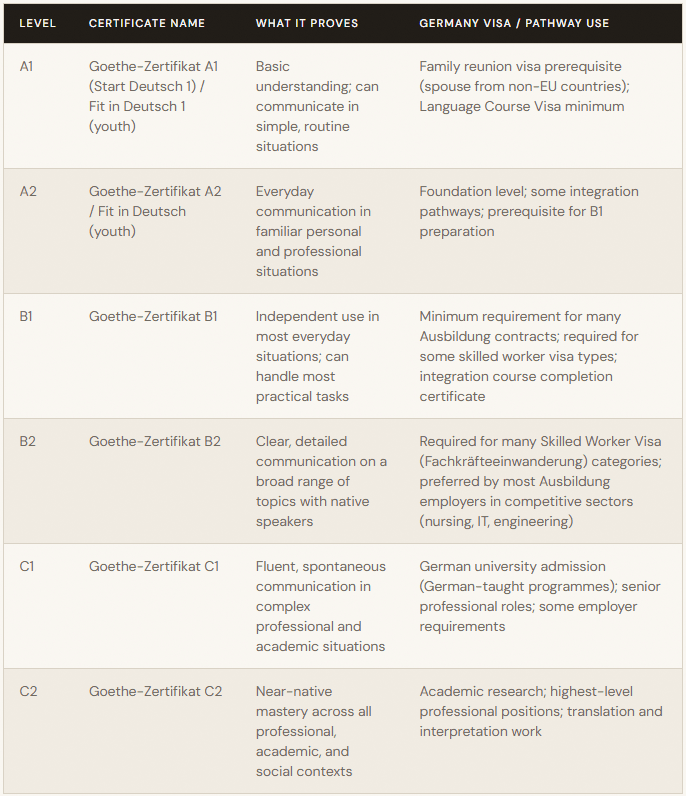
The certificates follow the Common European Framework of Reference for Languages (CEFR), the six-level scale from A1 (beginner) to C2 (near-native mastery). Every Goethe-Zertifikat aligns to a specific CEFR level. When a German embassy says "you need B1," a Goethe-Zertifikat B1 satisfies that requirement with no ambiguity.
In Sri Lanka, the Goethe-Institut operates from its Colombo 7 office at 39 Gregory's Road. Exams run throughout the year, with registration managed through the MyGoethe.de online portal. The institute has offered exams in Sri Lanka for decades. For candidates in Colombo, it remains the primary option for sitting a German language exam without travelling abroad. (Source: goethe.de/ins/lk, 2026)
Which Goethe Level Do You Need? A1 to C2 Explained
The Goethe-Institut offers exams at all six CEFR levels in Sri Lanka. Most Sri Lankan candidates need either B1 or B2, the two levels that cover the broadest range of Germany work and training visa types.
The majority of Sri Lankan candidates targeting Germany for Ausbildung, skilled work, or the Chancenkarte need B1 or B2. A1 and A2 are relevant primarily for family reunion visa applications, where a spouse joining a German resident must show basic language ability before entry. C1 and C2 are relevant for those pursuing German-taught university programmes or senior professional roles.
Start with the visa or pathway you are actually applying for. Check the specific language requirement for that visa type and target the level that meets it. Do not prepare for B1 if your pathway requires B2. The preparation investment is significant, and you want to sit the right exam first.
What the Goethe Exam Looks Like: Format and Structure
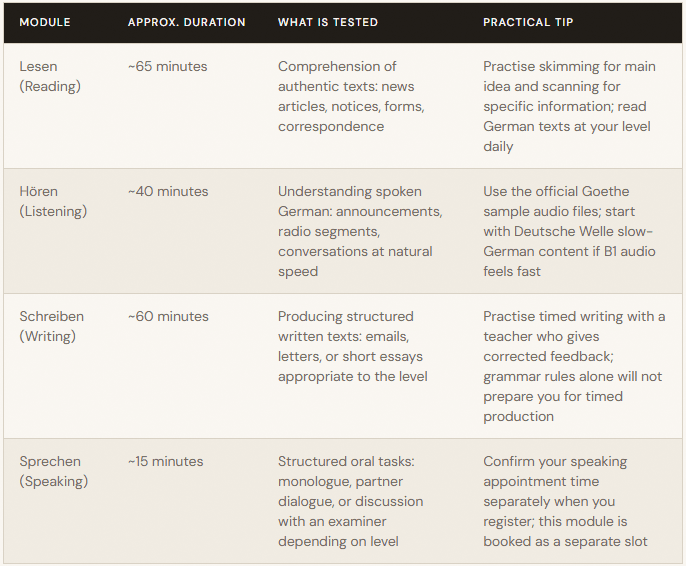
Every Goethe-Zertifikat exam tests the same four core language skills: Lesen (Reading), Hören (Listening), Schreiben (Writing), and Sprechen (Speaking). The written modules are usually sat in a single session; the Speaking module is typically booked separately and conducted face-to-face or via video. (Source: goethe.de, 2026)
The pass mark is 60% for each module. All four modules must be passed to receive the certificate. If you pass three modules but fail one, you can retake only the failed module. You do not resit the entire exam. There is no time limit on when you must retake a failed module. (Source: goethe.de, 2026)
Module retakes are one of the most practical features of the Goethe exam structure. If you sit the full exam and fail only the Speaking module, you pay only the Speaking module retake fee, not the full exam fee again. Ask Goethe-Institut Sri Lanka about the specific retake fee for your level when you register.
Goethe Exam Fees and 2026 Dates at Goethe-Institut Sri Lanka
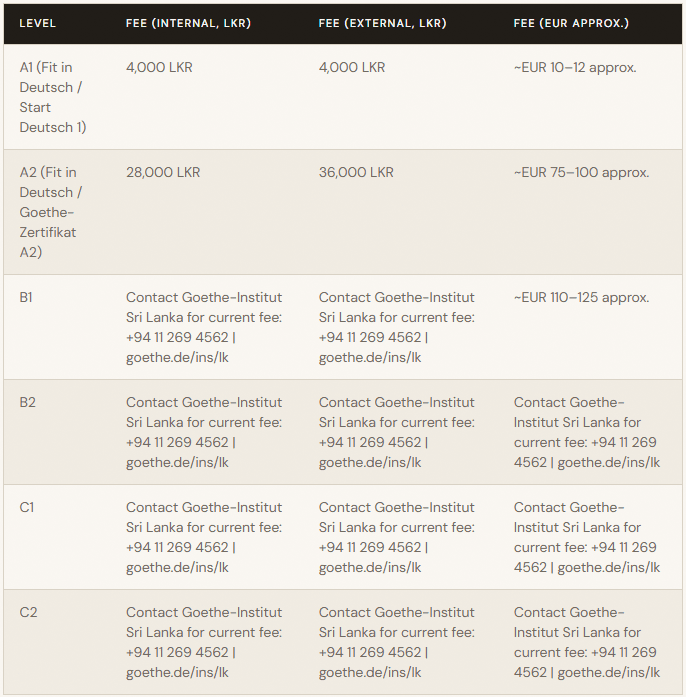
The fees below are sourced directly from goethe.de/ins/lk (Source: goethe.de/ins/lk, 2026). "Internal" candidates are those who have attended a Goethe-Institut Sri Lanka course within the past six months. External candidates are all others.
For Fit A1 and Fit A2, exam dates are arranged on request with a minimum of 10 participants. The next Fit A1 date for 2026 was listed as "to be announced soon" on the Goethe-Institut Sri Lanka website at the time of publication. B1, B2, C1, and C2 exam dates are confirmed directly through the Goethe-Institut. (Source: goethe.de/ins/lk, 2026)
Registration typically closes 4–6 weeks before the exam date. Do not leave registration until the last week, as popular levels and dates fill quickly, especially in the months before common visa application windows.
For the current 2026 exam schedule and latest fees in LKR, contact Goethe-Institut Sri Lanka directly: 39 Gregory's Road, Colombo 7 | +94 11 269 4562 | goethe.de/ins/lk
How to Register for the Goethe Exam in Sri Lanka: Step by Step
Registration for Goethe exams in Sri Lanka runs through the MyGoethe.de online portal. The process is straightforward, but read each step carefully; errors in candidate details on your registration can create complications on exam day.
Go to goethe.de/ins/lk and navigate to the Exams section. Review the available exam levels and confirm the level you need for your visa or pathway.
Create a MyGoethe.de account if you do not already have one, or log in to your existing account. All registration, confirmation, and results for Goethe exams worldwide use this single portal.
Select your exam level and preferred date. For A1 and A2 (Fit exams), contact Goethe-Institut Sri Lanka directly first, as these dates are arranged on request with a minimum of 10 participants.
Complete the online registration form. Use your name exactly as it appears on your national ID or passport, as this is what appears on your certificate.
Pay the exam fee as instructed; confirm payment method (bank transfer or online payment) and note the payment deadline. Your registration is not confirmed until payment is received.
Receive your exam confirmation and candidate number by email from Goethe-Institut Sri Lanka. Keep a printed copy of this confirmation.
On exam day: bring your confirmation printout, your national ID or passport (the same document used for registration), and one passport-size photograph for the Speaking module. Arrive at least 30 minutes before your scheduled start time.
Cancellation policy: if you cancel your exam registration within 30 days of the exam date, you typically forfeit the exam fee. Confirm the exact cancellation terms with Goethe-Institut Sri Lanka at the time of registration, as terms can vary by exam level. Contact Goethe-Institut Sri Lanka for current cancellation policy: +94 11 269 4562 | goethe.de/ins/lk
How Long to Prepare for Each Goethe Level
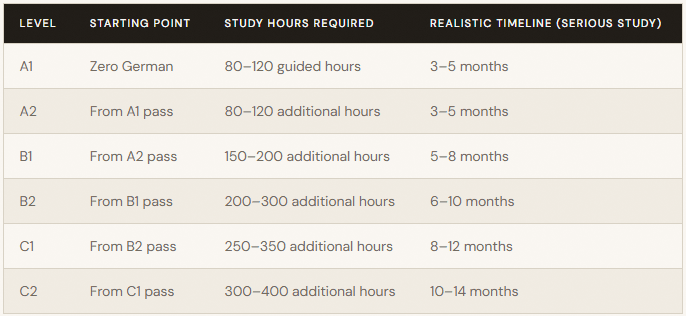
The time it takes to reach each level depends on your starting point and your weekly study hours. The table shows realistic timelines based on serious structured study, not casual exposure. The Council of Europe's own research places A1 at 80–150 guided hours from zero and B2 at 700–800 total hours. (Source: Council of Europe / ALTE research, 2020)
These are guided study hours, meaning time with a teacher, structured materials, and corrected written and spoken output. Self-study alone, particularly at B1 and above, tends to plateau without feedback on your writing and speaking. Most candidates who fail Goethe exams fail the Schreiben or Sprechen modules, the two skills that require production, not just recognition.
MALIROSA's online German courses from A1 to B2 include Goethe exam preparation modules, so you practise real task types before the exam. Each level progresses systematically, and exam preparation is built into the course rather than added as an afterthought. If your exam is in 5 months, start your structured preparation now, not two months before the date.
7 Things to Do Before Your Goethe Exam
Preparation does not end when the course ends. The week before your exam and the morning of your exam day both matter. These seven steps are based on what candidates who retake exams report doing differently the second time.
Arrive 30 minutes early. Latecomers are not admitted once the exam has started. Budget extra time for traffic in Colombo, as the Colombo 7 location on Gregory's Road is accessible but congested during peak hours.
Bring all required documents: your exam confirmation printout, your national ID card or passport (the exact document used during registration), and one passport-size photograph for the Speaking module.
Leave all electronic devices outside the exam room. Phones, smartwatches, and earphones are prohibited. You will be asked to place them in a bag or locker before entering.
For the Sprechen (Speaking) module: confirm your speaking appointment time in advance. Speaking is booked as a separate slot from the written modules. Double-check the time on your confirmation, as it is often different from the written exam time.
Practise with official Goethe sample papers at your level in the final two weeks. Official materials are available at goethe.de. The actual exam uses the same task types; practising unfamiliar task formats costs marks even if your German is strong.
Eat before the exam. Written sessions run 60–90 minutes without a break. Low concentration from hunger is a real and avoidable problem.
Remember that failing one module does not mean failing the exam. If your Hören result is not 60% but the other three modules are, only Hören needs to be retaken. Do not resit the full exam; contact Goethe-Institut Sri Lanka to register for the individual module retake.
Continue Your Journey
Structured A1–B2 courses built around real visa and career goals.
Randima Saiger is a co-founder of MALIROSA from Sri Lanka. She brings deep personal understanding of the Sri Lankan education system, family dynamics, and candidate aspirations, bridging local knowledge with Germany-side experience.
Is the Goethe certificate required for Germany visa applications from Sri Lanka?
The Goethe-Zertifikat is required by name for specific visa types, most notably family reunion visas and the Language Course Visa, where German law specifies that language proficiency must be demonstrated before entry. For other visa types such as the Ausbildung visa and the Skilled Worker Visa, German embassies accept several recognised certificates including Goethe, ÖSD, and telc. In practice, the Goethe-Zertifikat is universally accepted for all German visa categories that require language proof. The required level depends on the specific visa: A1 for family reunion, B1–B2 for work and training pathways. Check the exact requirement for your visa type on the German Embassy Colombo website before registering.
How much does the Goethe B1 exam cost in Sri Lanka?
The B1 exam fee was not published on goethe.de/ins/lk at the time this guide was written. For reference, confirmed 2026 fees at Goethe-Institut Sri Lanka are: Fit A1: 4,000 LKR (internal and external); Fit A2: 28,000 LKR internal / 36,000 LKR external. The B1 exam at Goethe centres globally is typically in the EUR 110–125 range. For the exact 2026 LKR fee for B1 in Sri Lanka, contact Goethe-Institut Sri Lanka directly: +94 11 269 4562 | goethe.de/ins/lk
When are the Goethe exam dates in Sri Lanka 2026?
Goethe-Institut Sri Lanka runs exams throughout the year. At the time of writing, the next Fit A1 date for 2026 was listed as "to be announced soon." Fit A2 dates are arranged on request with a minimum of 10 participants. B1, B2, C1, and C2 exam dates are available directly from Goethe-Institut Sri Lanka. For the full 2026 calendar, visit goethe.de/ins/lk or call +94 11 269 4562. Allow 4–6 weeks lead time; registration closes well before the exam date and popular slots fill quickly. (Source: goethe.de/ins/lk, 2026)
How long does it take to prepare for the Goethe B1 exam?
From A2 level, reaching B1 requires approximately 150–200 additional guided study hours. At 10 study hours per week, that is 15–20 weeks. At 20 hours per week, you can reach B1 in roughly 8–10 weeks. From zero German, reaching B1 requires 350–400 total guided hours, around 9–12 months at a standard study pace. Structured classes with a teacher who corrects your writing and speaking will move you through each level faster than self-study. MALIROSA's courses from A1 to B2 include Goethe exam preparation built in at each level.
Where is Goethe-Institut Sri Lanka located?
Goethe-Institut Sri Lanka is at 39 Gregory's Road, Colombo 7. Phone: +94 11 269 4562. Website: goethe.de/ins/lk. The address is in the Cinnamon Gardens area of Colombo. All exams for Sri Lanka are administered from this location. There is no second Goethe test centre in Sri Lanka; if you are outside Colombo, you will need to travel to Colombo 7 for the exam. (Source: goethe.de/ins/lk, 2026)
Can I retake the Goethe exam if I fail one module?
Yes. The Goethe exam is structured as four separate modules: Lesen (Reading), Hören (Listening), Schreiben (Writing), and Sprechen (Speaking). The pass mark for each module is 60%. If you pass three modules but fail one, only the failed module needs to be retaken. There is no time limit on when you must complete the retake. You pay only the retake fee for the individual module, not the full exam fee again. Contact Goethe-Institut Sri Lanka for the specific module retake fee and next available retake date for your level. (Source: goethe.de, 2026)
Is Goethe B1 enough for Ausbildung in Germany?
B1 is the stated minimum for many Ausbildung contracts, and the German embassy will accept a B1 certificate for the Ausbildung visa application. However, B2 is what most German training companies actually prefer, and in competitive sectors like nursing, IT, eldercare, and hospitality, B2 is increasingly a hard requirement rather than a preference. With B2, the range of employers and sectors available to Sri Lankan candidates expands dramatically compared to B1. MALIROSA recommends targeting B2 from the start unless your timeline for visa application makes B1 unavoidable. If you have B1 and are applying now, begin B2 preparation in parallel.
Start your German journey with courses built around the Goethe exam.
MALIROSA's A1 to B2 online courses are taught by certified instructors in Sri Lanka and include Goethe and OSD exam preparation at every level. You practise real exam task types throughout, so your exam sitting is a confirmation of what you already know, not a surprise. Apply for a course and a consultant will confirm your starting level before classes begin.
What German Level Do You Actually Need for Ausbildung, Work Visas, and Study in Germany?
Most people asking 'do I need German to go to Germany?' are really asking 'how much German do I need?' The answer depends entirely on your visa category. Here is the definitive breakdown.
Two Worlds, One Purpose: The Story Behind MALIROSA
MALIROSA grew from a decade of living the exact journey that our candidates are about to begin: between Sri Lanka and Germany, between two cultures, two languages, and two very different sets of expectations.
5 min read
Visa & Pathways
Family Reunion Visa Germany: Who Can Apply, What Is Required, and How Long It Takes
Germany granted over 100,000 family reunion visas in 2023. Most applicants wait between three and twelve months for an appointment at the German Embassy. Understanding the requirements before you apply can cut that wait significantly.
9 min read
Ausbildung
How to Find an Ausbildung Employer in Germany from Sri Lanka (2026 Guide)
You cannot show up in Germany and then find an Ausbildung employer. You need a signed training contract before your visa is approved. This guide covers every active portal, how to write applications German employers actually read, and the realistic timeline from first search to visa approval.