Ausbildung vs University Study in Germany | MALIROSA | Malirosa Pvt Ltd
Share
Ausbildung
9 min read
Ausbildung vs Studying in Germany: Which Path Is Right for You?
Germany offers two very different routes into a career: Ausbildung (paid vocational training) and university study. For Sri Lankan candidates, the right choice depends on your qualifications, financial situation, and career goals. Here is how to decide.
Over 73,000 Ausbildung positions went unfilled in Germany in 2023. University seats, by contrast, had 35,000 more applicants than places. Germany does not have a shortage of people who want degrees. It has a shortage of people willing to train. (Source: Bundesagentur für Arbeit, 2023; DAAD, 2023)
Ausbildung pays you a monthly stipend while you train, typically €700–1,100 per month depending on sector, and you start contributing to German social security from day one. University study, by contrast, usually means living on savings or a scholarship while you spend three or four years completing a degree, without any training income to cover your costs.
This guide compares both paths honestly, so you can make an informed decision rather than defaulting to one because it sounds more familiar.
What Is Ausbildung?
Ausbildung is Germany's dual vocational training system, regulated by the Berufsbildungsgesetz (BBiG). You sign a training contract with a German employer, attend a vocational school two days per week, and work at the employer the remaining three days.
Training typically lasts two to three years, after which you receive a nationally recognised qualification. Germany currently has over 300 recognised Ausbildung professions (Source: BIBB, Federal Institute for Vocational Education and Training, 2024). Popular sectors for international candidates include healthcare and nursing, hotel and hospitality, logistics and warehouse operations, retail, and technical trades such as mechatronics and electrical engineering.
Crucially, you are paid throughout. The national Ausbildungsmindestlohn (minimum training wage) is set under §17 BBiG and rises to €724 per month in the first training year for contracts starting in 2026 (up from €682 in 2025) (Source: BBiMindVergFBek 2026, BGBl. 2025 I Nr. 235), with many employers paying significantly more under collective bargaining agreements.
Duration: 2–3 years depending on the sector
Pay: €700–1,100/month (sector and employer dependent)
Language requirement: B1 minimum, B2 strongly preferred
Visa: §16a AufenthG (Berufsausbildung visa)
Outcome: Nationally recognised qualification + right to apply for skilled worker visa
What Is University Study in Germany?
Germany has approximately 400 universities and universities of applied sciences (Fachhochschulen). Public universities charge no tuition fees for undergraduate study: you pay only a semester contribution of roughly €100–350 per semester for administrative costs and public transport.
However, living costs in German cities run €800–1,200 per month (Source: Destatis / DAAD cost of living data, 2024). Without a scholarship or savings, funding three or four years is a significant financial challenge for most Sri Lankan families.
The visa for full-time study is the §16b Student Visa. You must show proof of sufficient funds, currently around €11,208 per year (Source: §2(3) AufenthG, 2024) in a blocked account, before the visa is issued.
Duration: 3 years (Bachelor) or 4–5 years (some programmes)
Tuition: €0 at public universities (plus €100–350/semester fees)
Living costs: €800–1,200/month (you must finance this yourself)
Language requirement: B2–C1 for German-language programmes, B2/IELTS for English-language programmes
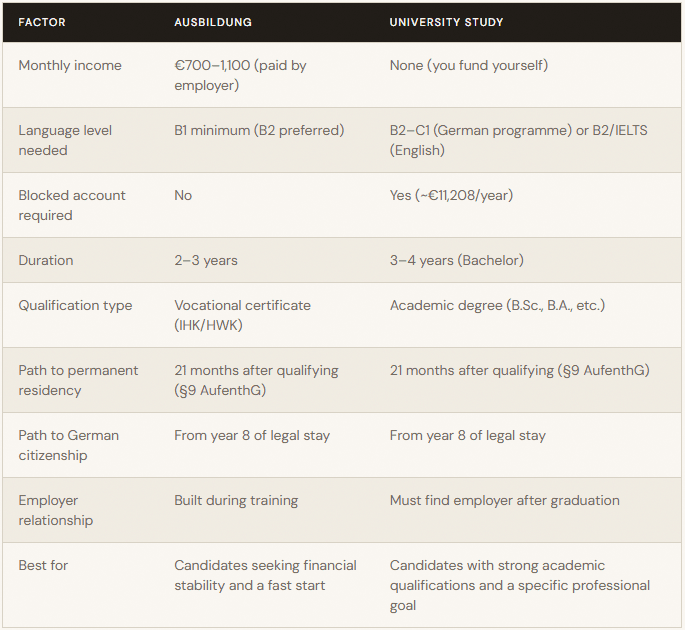
Here is how the two paths compare across the factors that matter most to Sri Lankan candidates.
The Language Reality
Language is the most common point of confusion. Candidates sometimes assume that because Germany has many English-taught Master's programmes, they can arrive with weak German. This is only partially true.
English-taught programmes exist almost exclusively at Master's level, requiring a completed Bachelor's degree first. For Bachelor's study and all Ausbildung, German is essential.
Ausbildung requires B1 to be granted the visa, but employers increasingly prefer B2. You will be communicating with colleagues, customers, and vocational school teachers in German every day. Treating B2 as the real target is the honest framing.
For university study in German, B2–C1 is typically required by the university itself. For an English-language Master's, you still need working German for daily life, dealing with authorities, and navigating your city.
Career Outcomes: What Happens After?
A common misconception is that a university degree automatically leads to better career outcomes than Ausbildung. In Germany's labour market, this is not reliably true. Germany's skilled labour shortage reached approximately 1.73 million unfilled positions in 2024, with vocational roles accounting for the majority of the gap. (Source: Institut der deutschen Wirtschaft, IW Köln, 2024)
Skilled tradespeople and qualified vocational workers are in genuine shortage. Germany posted over 73,000 unmatched Ausbildung positions in 2023 alone, meaning employers could not find enough candidates (Source: Bundesagentur für Arbeit, 2023). An IHK-certified healthcare specialist or logistics coordinator can earn €35,000–55,000 per year starting out, with clear paths to supervisory roles. In the trades, master craftsperson (Meister) status, which can be pursued after Ausbildung, is a professional qualification that opens the door to running your own business.
University graduates face a more competitive job market on graduation, and starting salaries in the first year can be comparable to or only modestly above those of experienced Ausbildung graduates. The degree advantage tends to become clearer after several years in more specialist or managerial roles.
Who Should Choose Ausbildung, and Who Should Choose University?
Choose Ausbildung if you want to start earning in Germany as quickly as possible, do not have savings to fund university living costs, are interested in a hands-on sector (healthcare, hospitality, logistics, trades), or have completed secondary school (A/L) but do not hold a university degree.
Consider university study if you have a specific professional goal that requires a degree (engineering, medicine, architecture, law), already hold a Bachelor's degree and are considering a German Master's, have access to a scholarship or family funding, or your A/L results and existing qualifications meet German university admission requirements.
Sri Lankan candidates who choose Ausbildung frequently go on to pursue further qualifications, including university-level study, after establishing themselves in Germany. Ausbildung is a beginning, not a ceiling.
How MALIROSA Helps You Decide
We do not push candidates toward one path or the other. Our job is to give you an honest assessment based on your current German level, qualifications, financial situation, and career goals, and then support you along whichever route fits.
For candidates choosing Ausbildung, we provide structured German language training from A1 to B2, support with German CV and motivation letter writing, employer outreach, and visa document preparation.
For candidates considering university study, we can advise on recognised qualification equivalency (anabin database), language requirements for target programmes, and the visa application process.
Continue Your Journey
Full Ausbildung preparation from language to visa.
Robert Saiger is a co-founder of MALIROSA with a background in Industrial Engineering & Management and Certified Consultant & Coach. Based in Konstanz, Germany, he brings direct expertise in Germany visa pathways, employer expectations, and the Sri Lankan qualification system.
Can I do Ausbildung if I already have a university degree from Sri Lanka?
Yes, having a university degree does not disqualify you from Ausbildung. Many candidates with Bachelor's degrees choose Ausbildung because it offers paid training, faster entry into the German workforce, and a clear route to residency. Some employers specifically value degree holders in sectors like healthcare management or technical trades. Your degree may even shorten the Ausbildung duration in some programmes.
Is Ausbildung respected in Germany, or is it seen as a lesser qualification?
Ausbildung qualifications are highly respected in Germany. The dual education system is a cornerstone of the German economy, and IHK/HWK-certified qualifications are nationally recognised across all 16 states. In many sectors, including healthcare, automotive, and logistics, an Ausbildung qualification is actively preferred over an academic degree for practical roles. Over 300 recognised professions use this system (Source: BIBB, 2024).
Do I need a blocked account for the Ausbildung visa?
No. The Ausbildung visa (§16a AufenthG) does not require a blocked account. Your training contract with a German employer, which includes your monthly stipend, replaces the need for proof of funds. This is one of the most significant financial advantages of Ausbildung over the student visa route, which requires approximately €11,208 per year in a blocked account (Source: German Federal Foreign Office, 2024).
Can I switch from Ausbildung to university study once I am in Germany?
Yes, this is a well-established path. After completing Ausbildung and working in Germany, many people pursue further qualifications including Meister, Techniker, or university programmes. Germany has bridging pathways (Studienkolleg, Aufstiegsstipendium scholarships) specifically designed for skilled workers who want to study at university level. It is a route, not a dead end.
Send a free enquiry with MALIROSA. We will review your qualifications, German level and goals, and give you an honest recommendation: Ausbildung, university, or another route entirely.
How to Apply for an Ausbildung Visa from Sri Lanka (2026 Step-by-Step Guide)
Most Sri Lankan Ausbildung visa applications are rejected not because candidates lack a training contract, but because their documents are incomplete or incorrectly certified. This step-by-step guide shows you exactly what the German Embassy in Colombo requires and how to avoid the errors that delay most applications by six months.
What German Language Level Do You Need for Ausbildung in Germany?
The German language requirement is the single biggest factor that determines whether a Sri Lankan candidate can pursue Ausbildung in Germany. Here is exactly what level you need, why it matters, and how long it takes to get there.
10 min read
Visa & Pathways
How to Move to Germany from Sri Lanka: Your Complete 2026 Pathway Guide
Germany had 1.73 million unfilled skilled-worker positions in 2024. Sri Lanka has hundreds of thousands of educated, ambitious young people with limited local opportunity. This guide is the map that connects those two facts into a plan you can actually follow.
12 min read
Our Story
Two Worlds, One Purpose: The Story Behind MALIROSA
MALIROSA grew from a decade of living the exact journey that our candidates are about to begin: between Sri Lanka and Germany, between two cultures, two languages, and two very different sets of expectations.
5 min read
Visa & Pathways
Family Reunion Visa Germany: Who Can Apply, What Is Required, and How Long It Takes
Germany granted over 100,000 family reunion visas in 2023. Most applicants wait between three and twelve months for an appointment at the German Embassy. Understanding the requirements before you apply can cut that wait significantly.