Sri Lankan Qualification Recognition in Germany: ANABIN, KMK & BIBB Guide | Malirosa Pvt Ltd
Share
Visa & Pathways
9 min read
How to Get Your Sri Lankan Qualifications Recognised in Germany
You have a degree or professional qualification from Sri Lanka. Germany wants skilled workers. But the German system needs to verify your qualifications before you can work or train in your field. This guide explains the three recognition pathways — ANABIN, KMK, and BIBB — and what to do at each stage.
Germany passed the Fachkräfteeinwanderungsgesetz (Skilled Immigration Act) in 2020 and expanded it significantly in 2023. The revised law opened recognition pathways for qualifications from 190 countries — including Sri Lanka. (Source: Bundesministerium des Innern / BMI, 2023) But recognition is not automatic. The German system requires your foreign degree or vocational qualification to be formally assessed against a German standard before you can work in your field, access a skilled worker visa, or use your professional title.
This is not a rejection. It is a process. Germany assesses foreign qualifications through three main systems: ANABIN for university degrees, KMK for teaching and certain professional qualifications, and BIBB for vocational and trade qualifications. Understanding which system applies to you is the first step.
This guide walks through each pathway, explains what to do when your qualification or university is not listed, and outlines the free advisory services available before you begin the formal process.
Why Qualification Recognition Matters for Sri Lankans Moving to Germany
Germany's skilled worker visa (Fachkraftvisa) and the Chancenkarte both require that your foreign qualifications are comparable to a German standard. Without recognition, you cannot use your professional title in Germany, access regulated professions such as nursing, engineering, or teaching, or qualify for skilled worker visa categories.
For Ausbildung applicants, the question is different. Ausbildung does not require prior qualification recognition because you are training from scratch in Germany. But if you already hold a nursing, engineering, or technical qualification from Sri Lanka, recognition can allow you to skip the Ausbildung entirely and move directly into professional employment.
Recognition also affects salary. A Sri Lankan engineer recognised as a qualified Ingenieur in Germany earns €3,500 to €5,000 per month. (Source: Bundesagentur für Arbeit EntgeltatlaS, Ingenieur, 2024) The same person without recognised credentials may only access trainee or assistant positions at €2,000 to €2,500.
ANABIN Database: Checking Your University Degree
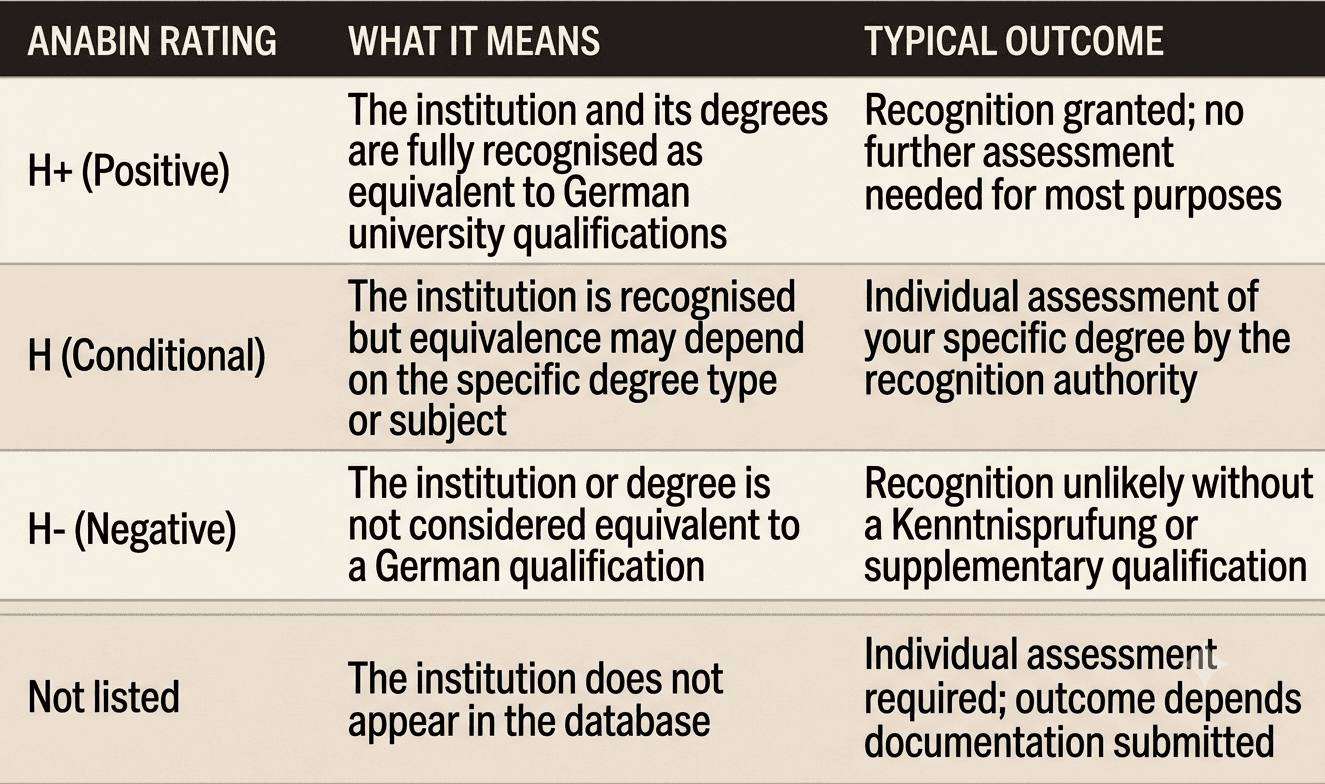
ANABIN is a database maintained by the Standing Conference of the Ministers of Education and Cultural Affairs of the German states (KMK). It catalogues universities and qualifications from around the world, assigning them a rating that indicates their comparability to German degrees.
Access ANABIN at anabin.kmk.org. Search for your institution by country (Sri Lanka) and university name.
Sri Lanka context: The University of Colombo, University of Peradeniya, University of Moratuwa, and several other national universities appear in ANABIN. Private higher education institutions in Sri Lanka may not be listed. If your institution is not in ANABIN, you are not automatically rejected. You proceed to individual assessment.
KMK Recognition: Teaching and Professional Qualifications
The KMK (Kultusministerkonferenz) handles recognition for teaching qualifications and certain state-regulated professional titles. If you trained as a teacher in Sri Lanka and want to teach in Germany, KMK recognition through the relevant German state (Bundesland) is the pathway.
Each German state handles KMK recognition independently. The application goes to the state ministry of education (Kultusministerium) in whichever state you plan to live and work. There is no single national authority.
For teaching specifically, German states assess whether your subject specialisation, pedagogical training hours, and practical teaching experience meet the requirements for the equivalent German teaching qualification (Lehramt). Candidates often need to complete a probationary teaching period (Referendariat) or pass subject-specific examinations.
KMK recognition is also relevant for certain healthcare and legal professional titles that vary by state regulation. Your profession determines which authority handles the assessment.
BIBB Recognition: Vocational and Trade Qualifications
BIBB (Bundesinstitut für Berufsbildung) handles recognition for vocational and trade qualifications. This is the relevant pathway if you hold a qualification from Sri Lanka in a technical, craft, or trade field that was not earned at a university.
Examples include: technical diplomas in electrical work, plumbing, or construction; trade certificates in automotive mechanics, cookery, or welding; and professional qualifications in accountancy or office administration at the vocational level.
Under the Berufsqualifikationsfeststellungsgesetz (BQFG, Federal Law of 2012, last amended 2023), you have a legal right to have your foreign vocational qualification assessed against the relevant German Ausbildungsberuf (training profession). The assessment is carried out by the competent body (zustandige Stelle) for the profession, which may be a Chamber of Commerce (IHK), Chamber of Crafts (HwK), or another professional body.
The BIBB recognition portal (anerkennung-in-deutschland.de) provides a step-by-step tool to identify which authority handles recognition for your specific profession.
IQ-Netzwerk: Free Advisory Centres Across Germany
The IQ-Netzwerk (Netzwerk Integration durch Qualifizierung) is a federal programme operating 24 regional networks across Germany. It provides free qualification recognition counselling to people with foreign qualifications.
IQ advisers can review your Sri Lankan documents, explain which recognition pathway applies to your qualification, help you gather the correct documentation, and refer you to the appropriate formal assessment authority.
Crucially, IQ counselling is available before you arrive in Germany. You can access telephone or video consultations from Sri Lanka before committing to the formal recognition process. This is particularly valuable for candidates who want to understand their prospects before investing in document translation and apostille costs.
Find your nearest regional IQ-Netzwerk centre at netzwerk-iq.de. The counselling service is free and available in multiple languages.
Anerkennungsberatung: Online Advisory Before You Arrive
Anerkennungsberatung is Germany's official pre-arrival recognition counselling service. It is designed for internationally trained professionals who are still outside Germany and considering a move.
The service assesses your specific qualifications against German requirements, identifies which recognition pathway you need, and gives you a realistic picture of your recognition prospects before you begin the formal process.
Access Anerkennungsberatung through the Make It in Germany portal (make-it-in-germany.com) or the BAMF website. Sessions are free and available in English.
Completing Anerkennungsberatung before you start gathering documents saves significant time and money. You learn exactly which documents are needed, which translation services are acceptable, and what to expect from the timeline.
Kenntnisprufung vs Anpassungslehrgang: When Recognition Is Partial
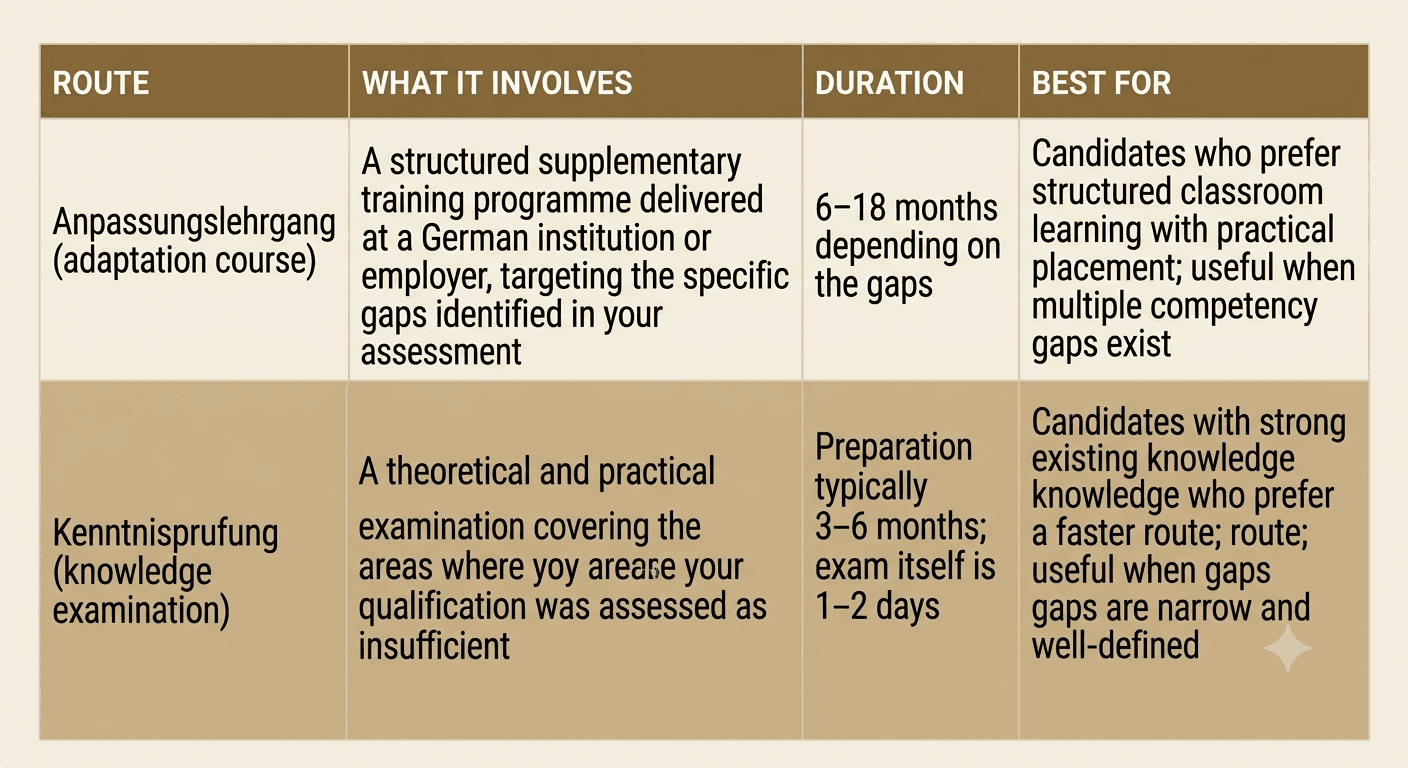
Most Sri Lankan qualifications assessed against German standards receive partial recognition. The German authority identifies specific gaps between your training and the German requirement. You then choose one of two routes to bridge those gaps.
You do not have to choose before the assessment. The recognition authority will specify which route is available for your qualification gap. In some professions, only one route is permitted by regulation.
Sri Lanka-Specific: Documents, Apostille, and Translation
Sri Lanka acceded to the Hague Apostille Convention in 2000, meaning Sri Lankan official documents apostilled by the relevant Sri Lankan authority are accepted by German institutions without further legalisation. (Source: Hague Conference on Private International Law, apostille member list)
Documents you will typically need for a recognition application include: your degree certificate or diploma, official transcripts listing subjects and grades, proof of the duration of your study programme, and proof of any professional experience.
All documents must be accompanied by certified German translations. German recognition authorities do not accept translations made by the applicant. You need a sworn translator (vereidigter Dolmetscher) registered in Germany.
MALIROSA coordinates certified translation of Sri Lankan documents as part of its visa and recognition support service, using translators registered with the relevant German state courts.
Recognition Timeline: What to Expect
The formal recognition process typically takes three to six months from the date the recognition authority receives a complete application. (Source: Bundesministerium für Bildung und Forschung / BMBF recognition statistics, 2023) Incomplete applications, missing documents, or unusually complex cases can extend this to nine to twelve months.
The main time variables are: how quickly you gather and translate your documents, how long the apostille process takes in Sri Lanka (usually two to four weeks), and the current workload at the German recognition authority you are applying to.
Starting the Anerkennungsberatung advisory process first, before you gather any documents, reduces mistakes and wasted effort. Candidates who skip the advisory stage often submit incomplete applications and add months to the process.
Continue Your Journey
Get structured guidance on every Germany visa pathway.
Randima Saiger is a co-founder of MALIROSA from Sri Lanka. She brings deep personal understanding of the Sri Lankan education system, family dynamics, and candidate aspirations, bridging local knowledge with Germany-side experience.
Will my Sri Lankan degree be recognised in Germany?
It depends on your institution and subject. Check the ANABIN database (anabin.kmk.org) to see whether your university appears and what rating it has received. Sri Lankan national universities including the University of Colombo, University of Peradeniya, and University of Moratuwa are listed in ANABIN. If your institution is listed as H+ or H, your degree has a strong basis for recognition. If it is not listed, individual assessment is required and the outcome depends on the documentation you submit. Most Sri Lankan degrees from national universities receive some level of recognition, though partial recognition requiring a Kenntnisprufung or Anpassungslehrgang is common.
What is the ANABIN database and how do I use it?
ANABIN is a database maintained by the KMK (Germany's Standing Conference of Education Ministers) that catalogues universities and qualifications from over 180 countries. To check your Sri Lankan qualification, visit anabin.kmk.org, select "Institutionen" or "Abschlusse", then search by country (Sri Lanka) and institution name. The database will show whether your university is rated H+ (fully equivalent), H (conditional), H- (not equivalent), or not listed. This rating guides the recognition authority's initial assessment of your degree.
How long does qualification recognition take in Germany?
The formal recognition process typically takes three to six months from the date the recognition authority receives a complete application. This timeline assumes all documents are submitted correctly with certified German translations and apostille stamps. Incomplete applications extend the process to nine to twelve months. Starting with free Anerkennungsberatung advisory (available at make-it-in-germany.com) before gathering documents helps ensure your application is complete and avoids common delays.
What if my Sri Lankan qualification is not in ANABIN?
If your university is not in ANABIN, you are not automatically rejected. The recognition authority will carry out an individual assessment based on the documentation you submit. You will need to provide your degree certificate, official transcripts, course descriptions, and proof of the study programme's duration. The IQ-Netzwerk (netzwerk-iq.de) can help you prepare your application and advise on which additional documents strengthen your case. The outcome of individual assessment is less predictable than for listed institutions, so early advisory is especially important.
Does qualification recognition cost money?
The formal recognition application itself costs between €100 and €600 depending on the profession and the assessment authority. Document translation costs vary; a certified German translation of a standard degree certificate typically costs €80 to €200 per document. Apostille fees in Sri Lanka are modest. Advisory services through the IQ-Netzwerk and Anerkennungsberatung are free. MALIROSA coordinates document translation and apostille support as part of its visa and recognition service for Sri Lankan candidates.
Unsure whether your qualifications will be recognised in Germany?
MALIROSA's consultants have helped Sri Lankan candidates navigate the German recognition process across nursing, technical, and business qualifications. Submit your documents for a free 30-minute written assessment. We review your specific qualifications, identify the recognition pathway that applies, and advise on the documents you need to start.
How to Move to Germany from Sri Lanka: Your Complete 2026 Pathway Guide
Germany had 1.73 million unfilled skilled-worker positions in 2024. Sri Lanka has hundreds of thousands of educated, ambitious young people with limited local opportunity. This guide is the map that connects those two facts into a plan you can actually follow.
Nursing Ausbildung in Germany: Salary, Requirements and How to Apply (2026)
Germany has 140,000+ unfilled nursing positions and is actively recruiting internationally. A nursing Ausbildung pays €1,000–1,300/month during training and leads to a qualified salary of €2,800–3,400 after completion. This guide covers the two nursing programmes, real salary figures, language requirements, Sri Lankan degree recognition, and how to find a hospital employer.
10 min read
German Language
What German Level Do You Actually Need for Ausbildung, Work Visas, and Study in Germany?
Most people asking 'do I need German to go to Germany?' are really asking 'how much German do I need?' The answer depends entirely on your visa category. Here is the definitive breakdown.
7 min read
Our Story
Two Worlds, One Purpose: The Story Behind MALIROSA
MALIROSA grew from a decade of living the exact journey that our candidates are about to begin: between Sri Lanka and Germany, between two cultures, two languages, and two very different sets of expectations.
5 min read
Ausbildung
How to Find an Ausbildung Employer in Germany from Sri Lanka (2026 Guide)
You cannot show up in Germany and then find an Ausbildung employer. You need a signed training contract before your visa is approved. This guide covers every active portal, how to write applications German employers actually read, and the realistic timeline from first search to visa approval.