How Long to Learn German A1 to B2 (Honest Timeline) | Malirosa Pvt Ltd
Share
German Language
9 min read
How Long Does It Take to Learn German from A1 to B2? An Honest Timeline
The official European framework says B2 takes 560 to 600 guided learning hours. Most online guides say "six months." Neither figure is useful without context. Here is an honest breakdown of what each level actually requires.
The Council of Europe's own research puts B2 German at 700–800 total guided learning hours from zero. Most online guides say "six months." That gap between what the data shows and what people expect is the single reason most Sri Lankan candidates miss their visa window. (Source: Council of Europe CEFR guidelines, 2020)
The honest answer to "how long does German take?" depends on four factors: your starting point, your study intensity, the quality of your instruction, and the consistency of your practice. This guide breaks down each level, gives you a realistic hour count, and explains what actually moves people through the framework faster.
By the end of this guide you will know exactly where you stand, how long your preparation realistically takes, and what to do today to make that timeline shorter.
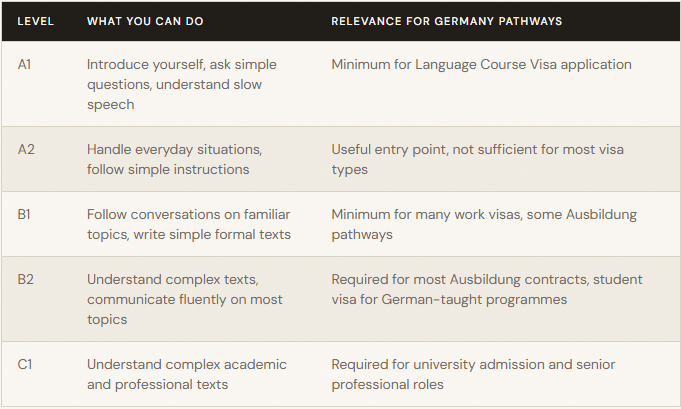
The CEFR Framework and What Each German Level Actually Means
German language levels are measured using the Common European Framework of Reference for Languages (CEFR), which runs from A1 at the bottom to C2 at the top. For Germany immigration purposes, most candidates need to reach between B1 and B2. Understanding what each level means in practical terms helps you set goals that are connected to reality.
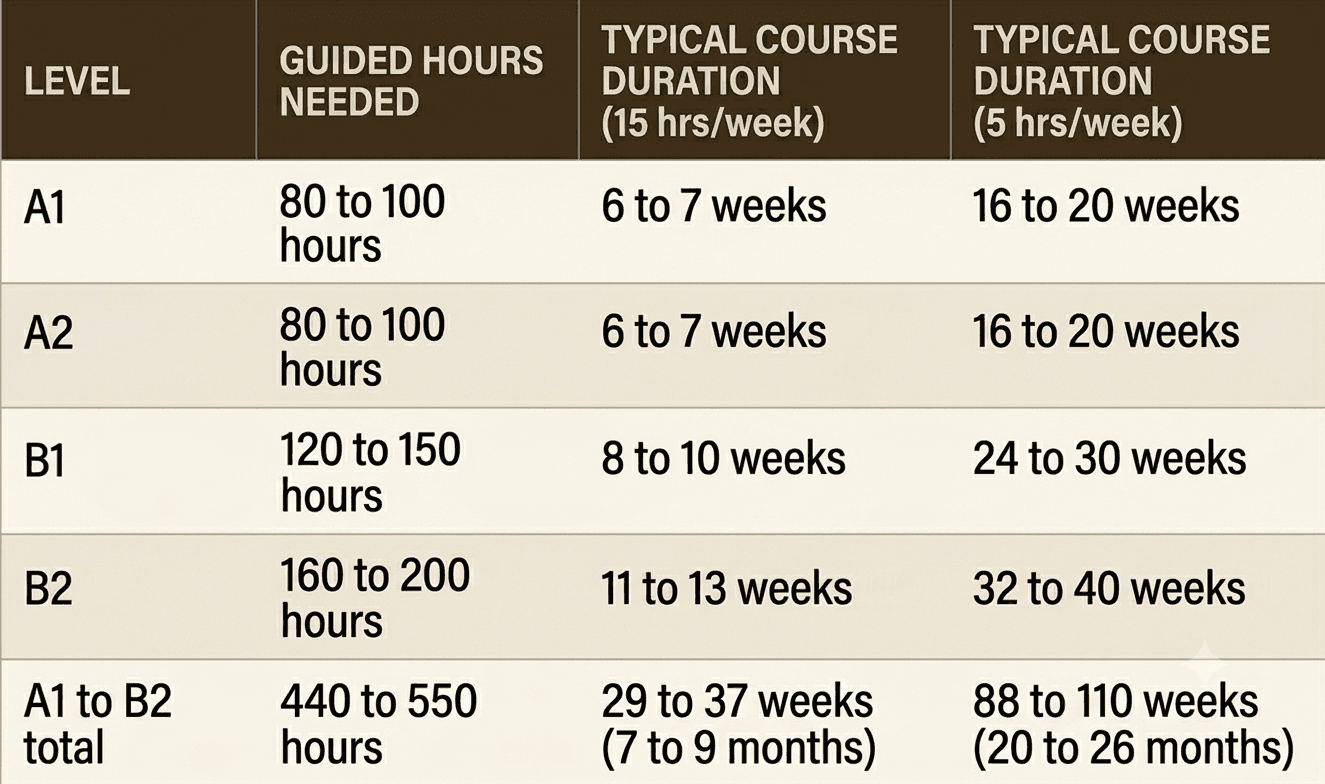
Guided Learning Hours Required for Each Level
The Council of Europe publishes reference data on expected guided learning hours per level, used by Goethe-Institut and ÖSD to set their curricula. These are hours of structured instruction, not passive exposure. (Source: Council of Europe / ALTE research, 2020) Watching German television counts for something, but it does not replace structured grammar and speaking practice.
The difference between seven months and twenty-six months is entirely explained by study intensity. Candidates who treat German as a weekend activity and expect to reach B2 in under a year are setting themselves up for a missed visa window.
What Genuinely Accelerates Your Progress Through the Levels
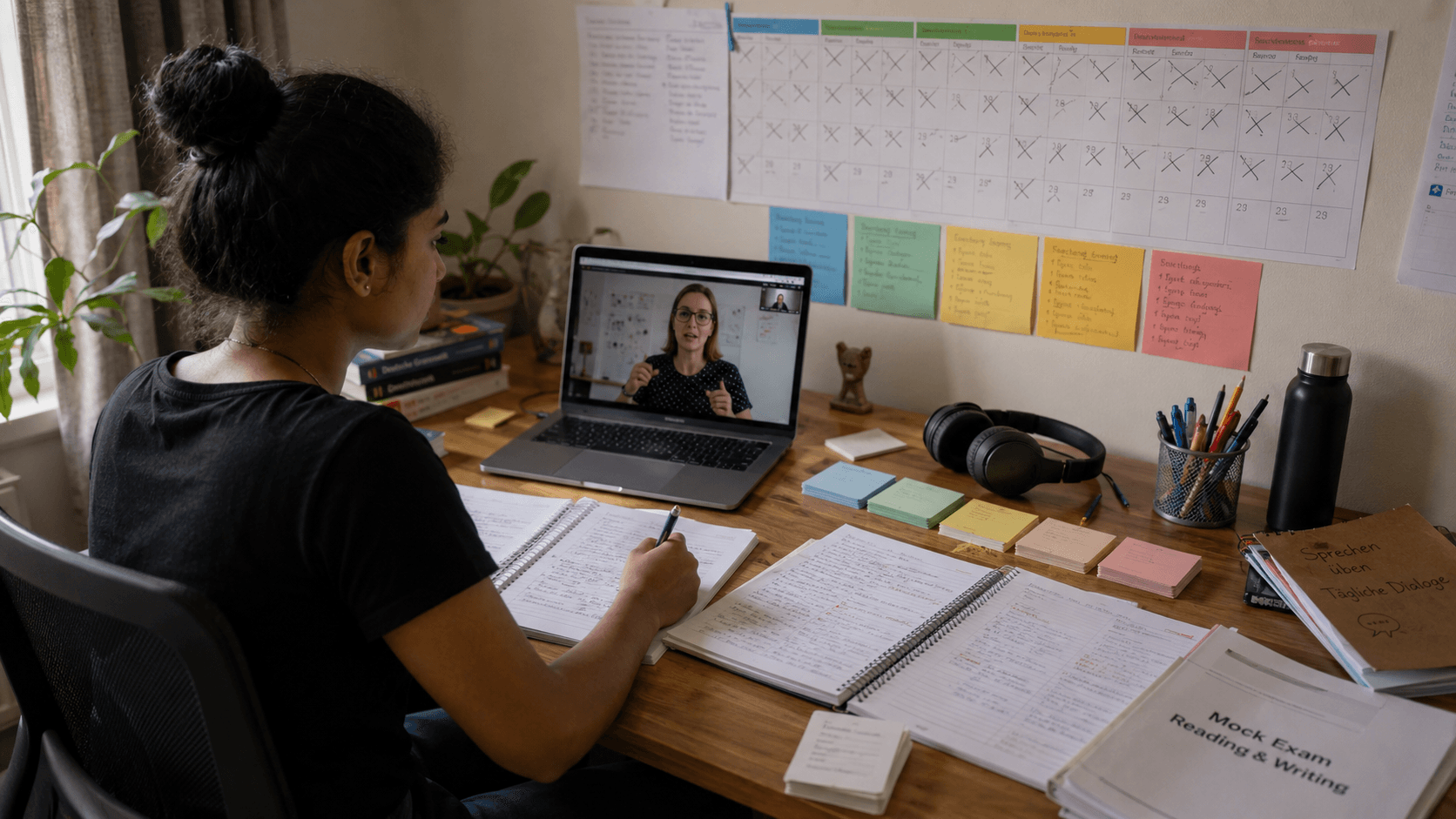
Hours matter, but not all hours are equal. Candidates who reach B2 in ten to twelve months from zero typically share a common set of habits.
Daily speaking practice with a qualified teacher. Grammar rules learned without speaking practice produce candidates who can pass written exams but cannot hold a conversation. MALIROSA structures lessons to develop both skills in parallel.
Consistent daily exposure, even in short sessions. Thirty minutes of focused practice every day beats three hours on Saturday. The brain consolidates language during sleep. Regular short exposures build retention faster than irregular long sessions.
Early focus on pronunciation and listening. Candidates who neglect listening comprehension struggle at B1 and above, because exam listening sections and real conversations move at speeds that require trained ears.
German in context, not just grammar drills. Vocabulary attached to real situations, professions, and topics you care about is retained five to ten times better than lists learned in isolation.
Regular mock tests before the real exam. The Goethe Institut and ÖSD exams have specific formats. Candidates who practice under exam conditions perform significantly better than those who study the content without simulating the test environment.
Three Things That Slow Candidates Down and How to Avoid Them
These patterns appear consistently among candidates who take longer than necessary to reach their target level.
Repeating A2 indefinitely. Some learners reach A2 and feel comfortable. They slow down, revisit material they already know, and avoid the more demanding grammar structures at B1. B1 is harder than A2. Expect that and push through rather than delaying.
Studying alone without feedback. Self-study apps and YouTube videos can supplement instruction but they cannot replace a teacher who identifies your specific errors. Most learners who rely entirely on self-study develop confident but grammatically incorrect speaking habits that are difficult to fix at higher levels.
Waiting until your German is "ready" to practice speaking. There is no point at which you feel ready. Candidates who start speaking from the first lesson progress faster than those who wait until they feel confident. Discomfort at A1 is normal. Avoiding it costs months.
German Language Training at MALIROSA: Structure and What to Expect
Classes are taught online, which means you can begin immediately regardless of where you are in Sri Lanka. MALIROSA is also planning physical classroom options in Sri Lanka as the programme expands. Group and individual class formats are available depending on your learning goals and schedule.
Course content is aligned with the Goethe Institut and ÖSD exam frameworks so that your preparation directly translates to recognised certificates. Recognised certificates are required for visa applications and most Ausbildung applications. A language course that does not prepare you for an accredited exam is not sufficient for your German immigration goals.
Every MALIROSA candidate begins with an honest assessment of their current level and receives a realistic learning plan based on their visa timeline and pathway goals. If your Ausbildung start date requires B2 in fourteen months, your course schedule is built to match that target.
Continue Your Journey
Structured A1–B2 courses built around real visa and career goals.
Randima Saiger is a co-founder of MALIROSA from Sri Lanka. She brings deep personal understanding of the Sri Lankan education system, family dynamics, and candidate aspirations, bridging local knowledge with Germany-side experience.
It is possible but requires intense study: twelve to fifteen guided hours per week plus daily independent practice. For most working adults or students, this intensity is not sustainable. A realistic and achievable target for most candidates starting from zero is twelve to eighteen months to reach B2 with consistent effort in a structured programme.
Which German certificate is accepted for Ausbildung visa applications?
The most widely accepted certificates are the Goethe Institut exams (Goethe-Zertifikat A1 through C1), the ÖSD certificates, and the telc German language certificates. Each has an equivalent CEFR level. When applying for an Ausbildung visa or submitting to a German employer, check that your certificate is listed among accepted qualifications for your specific pathway.
Is A2 German enough for Ausbildung in Germany?
No, in most cases. The vocational school component of Ausbildung is conducted entirely in German and covers complex technical vocabulary from your first semester. Most employers and training schools require at minimum B1, and B2 is strongly preferred because it reduces the language gap during the training period and improves your chance of passing vocational school exams.
Do I need a German certificate to take MALIROSA courses?
No. MALIROSA accepts candidates at every level including complete beginners. If you have no prior German experience, you begin at A1. If you have studied before, MALIROSA conducts a placement assessment to identify your correct starting level so you are not repeating material you already know.
What is the difference between guided learning hours and total study hours?
Guided learning hours refer to time spent in structured instruction with a teacher, whether online or in class. Total study hours include guided hours plus independent study: homework, vocabulary review, listening practice, and speaking exercises. For every guided hour, effective learners typically spend one to two additional hours in independent practice.
Start Your German Today. The Timeline Is in Your Hands.
Every week you delay starting German adds a week to your overall pathway timeline. MALIROSA offers online German classes from A1 to B2 with clear exam preparation and a learning schedule built around your visa goals. Register your interest now and our team will contact you with a free level assessment and a realistic timeline for your pathway.
What German Level Do You Actually Need for Ausbildung, Work Visas, and Study in Germany?
Most people asking 'do I need German to go to Germany?' are really asking 'how much German do I need?' The answer depends entirely on your visa category. Here is the definitive breakdown.
How to Move to Germany from Sri Lanka: Your Complete 2026 Pathway Guide
Germany had 1.73 million unfilled skilled-worker positions in 2024. Sri Lanka has hundreds of thousands of educated, ambitious young people with limited local opportunity. This guide is the map that connects those two facts into a plan you can actually follow.
12 min read
Ausbildung Germany
German Motivation Letter for Ausbildung: What to Write and What Loses You the Place
Most Ausbildung applications fail before anyone reads the CV. The Motivationsschreiben is the first thing a German training company reads, and most international candidates get it completely wrong. Here is what actually works, including a real example.
10 min read
Our Story
Two Worlds, One Purpose: The Story Behind MALIROSA
MALIROSA grew from a decade of living the exact journey that our candidates are about to begin: between Sri Lanka and Germany, between two cultures, two languages, and two very different sets of expectations.
5 min read
Visa & Pathways
Family Reunion Visa Germany: Who Can Apply, What Is Required, and How Long It Takes
Germany granted over 100,000 family reunion visas in 2023. Most applicants wait between three and twelve months for an appointment at the German Embassy. Understanding the requirements before you apply can cut that wait significantly.