How to Find an Ausbildung Employer in Germany (2026) | Malirosa Pvt Ltd
Share
Ausbildung
11 min read
How to Find an Ausbildung Employer in Germany from Sri Lanka (2026 Guide)
You cannot show up in Germany and then find an Ausbildung employer. You need a signed training contract before your visa is approved. This guide covers every active portal, how to write applications German employers actually read, and the realistic timeline from first search to visa approval.
As of October 2024, Germany had over 62,000 unmatched Ausbildung positions still open for the current intake year, with roughly 8,000 new positions published every month in the major training sectors. (Source: Bundesagentur fur Arbeit, Ausbildungsmarkt report, October 2024) Finding the right employer is not about luck. It is about knowing where to look and what to send when you find them.
The sequence catches many applicants off guard: you must secure a German employer, negotiate and sign a training contract, and have that contract verified by the Federal Employment Agency, all before you set foot on a plane. This guide walks through where to search, how to apply so German employers actually respond, what MALIROSA's employer search service does, and what the realistic timeline looks like.
Why You Need the Contract Before You Apply for the Visa
The Ausbildung visa (officially: Visum zur Berufsausbildung) requires a confirmed, signed Ausbildungsvertrag as a mandatory document. Without it, the embassy cannot assess whether you will be paid, what sector you are entering, or whether the training company is accredited. (Source: Federal Foreign Office, make-it-in-germany.com, 2026)
Once you have a signed contract, either you or your employer submits it to the Bundesagentur fur Arbeit (Federal Employment Agency). The BA reviews whether the training position meets legal standards and gives approval. The embassy then issues your visa based on that approved contract.
This differs from the student visa process, where a university admissions letter is your anchor document. For Ausbildung, your employer is your anchor.
Do not apply for a tourist visa with the intention of finding an employer in Germany and then converting to an Ausbildung visa. This route is unreliable, frowned upon by immigration authorities, and usually fails. Secure the contract from Sri Lanka first.
Where to Search: The Active Job Portals
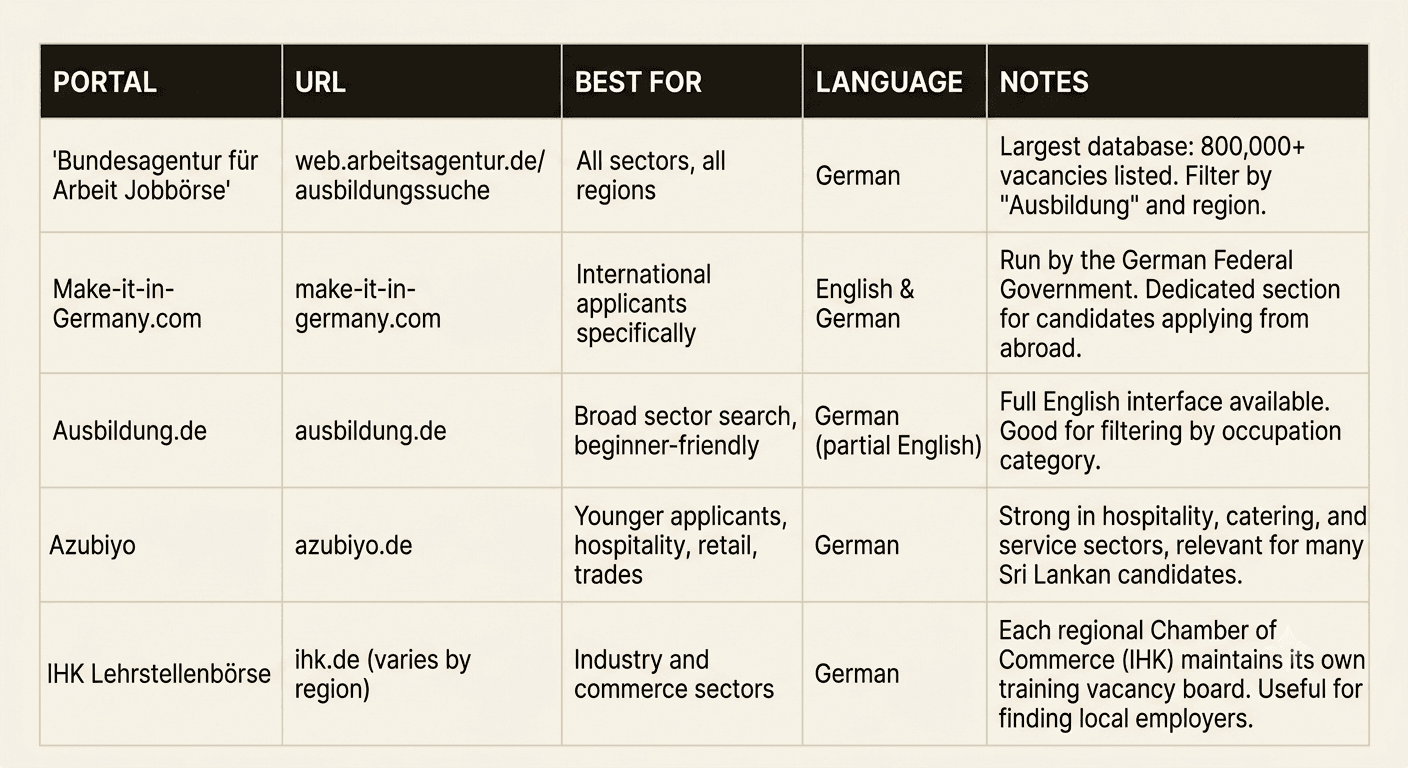
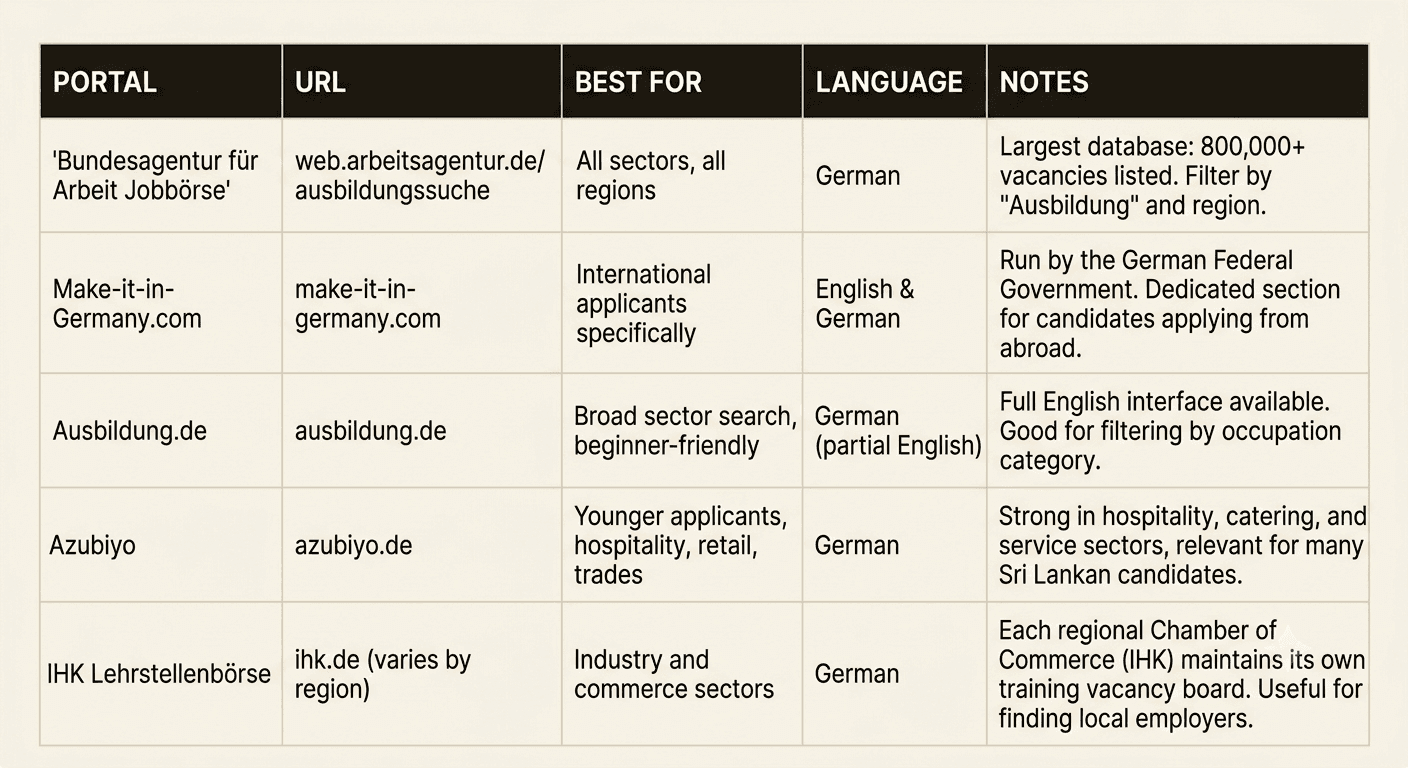
These are the five portals Sri Lankan applicants should use. All five list genuine Ausbildung positions and are updated regularly. (Source: Bundesagentur für Arbeit; make-it-in-germany.com; liveingermany.de, 2026)
The Federal Employment Agency's official Ausbildungsstellensuche portal (ausbildungsstellensuche.arbeitsagentur.de) lists employer-verified openings directly and is free to use. Listings on this portal represent committed training positions, not speculative postings.
When searching on the Bundesagentur portal, use the search term "Ausbildung" and filter by your target region. Large cities like Frankfurt, Stuttgart, Hamburg, and Munich have the highest volumes of vacancies but also the highest cost of living. Cities like Nuremberg, Mannheim, and Freiburg have strong vacancy counts with lower living costs.
How to Write an Application German Employers Actually Respond To
German employers receive hundreds of applications for popular Ausbildung positions. International applicants who do not adapt their documents to German conventions are filtered out immediately. Not because of discrimination, but because a CV formatted for UK or Sri Lankan conventions signals that the candidate has not researched the role or the country.
German training companies respond best to direct enquiries that demonstrate research. Mentioning the company's specific Ausbildungsberufe, acknowledging the training duration and structure, and stating your German certificate level and expected availability date are concrete signals that reduce employer risk. Generic interest letters are almost never forwarded to hiring managers. (Source: BIBB Datenreport, 2024)
Here is what German employers look for from international candidates, based on standard hiring practice and feedback from German HR teams working with international trainees:
Cover letter (Anschreiben) is mandatory: This is not optional in Germany. A 1-page letter in German explaining specifically why you want to train at this company, in this occupation, in this city. Generic letters are deleted. Mention something specific about the company or sector.
Tabular CV (Tabellarischer Lebenslauf): German CVs follow a strict format: photo, personal details, education in reverse chronological order, work experience, language skills, hobbies. The CV should be 1–2 pages maximum.
Certified document translations: Your A-levels, O-levels, and any certificates must be translated into German by a certified translator. German employers cannot assess Sri Lankan qualifications without translations.
German language certificate: Include your Goethe-Institut or OSD certificate. B1 is the minimum most employers accept; B2 makes you significantly more competitive. List your level clearly on the CV.
Proof of motivation to stay: Employers are cautious about international applicants leaving mid-training. Your cover letter should address this directly; explain your long-term plan in Germany, your reasons for choosing this profession, and why you are committed to completing the full training period.
Response time: German employers post positions months in advance and fill them quickly. Apply within the first 2 weeks of a posting appearing. Late applications are often reviewed only as backups.
Write your cover letter and CV in German, not English, even if the job posting was in English. German employers reviewing Ausbildung applications expect German-language documents as a basic competency signal. If your German is not yet strong enough for a professional cover letter, that is a sign you need more language preparation before applying.
The MALIROSA Employer Search Service
Searching portals from Sri Lanka while working around language barriers, time zone differences, and unfamiliar German application conventions is slow and often unsuccessful without guidance. MALIROSA offers a dedicated employer search and matching service for Sri Lankan Ausbildung candidates.
Here is how it works:
Assessment: MALIROSA reviews your qualifications, German language level, target occupation, and preferred region. We identify which sectors and employer types are realistic matches for your profile.
Document preparation: We help you write a German-standard cover letter and CV. We advise on which documents need certified translation and which Sri Lankan institutions provide recognised certificates.
Targeted search: We use both the public portals and our network of German employers who have previously hired international trainees to identify live openings that match your profile.
Application submission: We submit applications on your behalf or co-submit with you, ensuring formatting and German language quality meet German HR expectations.
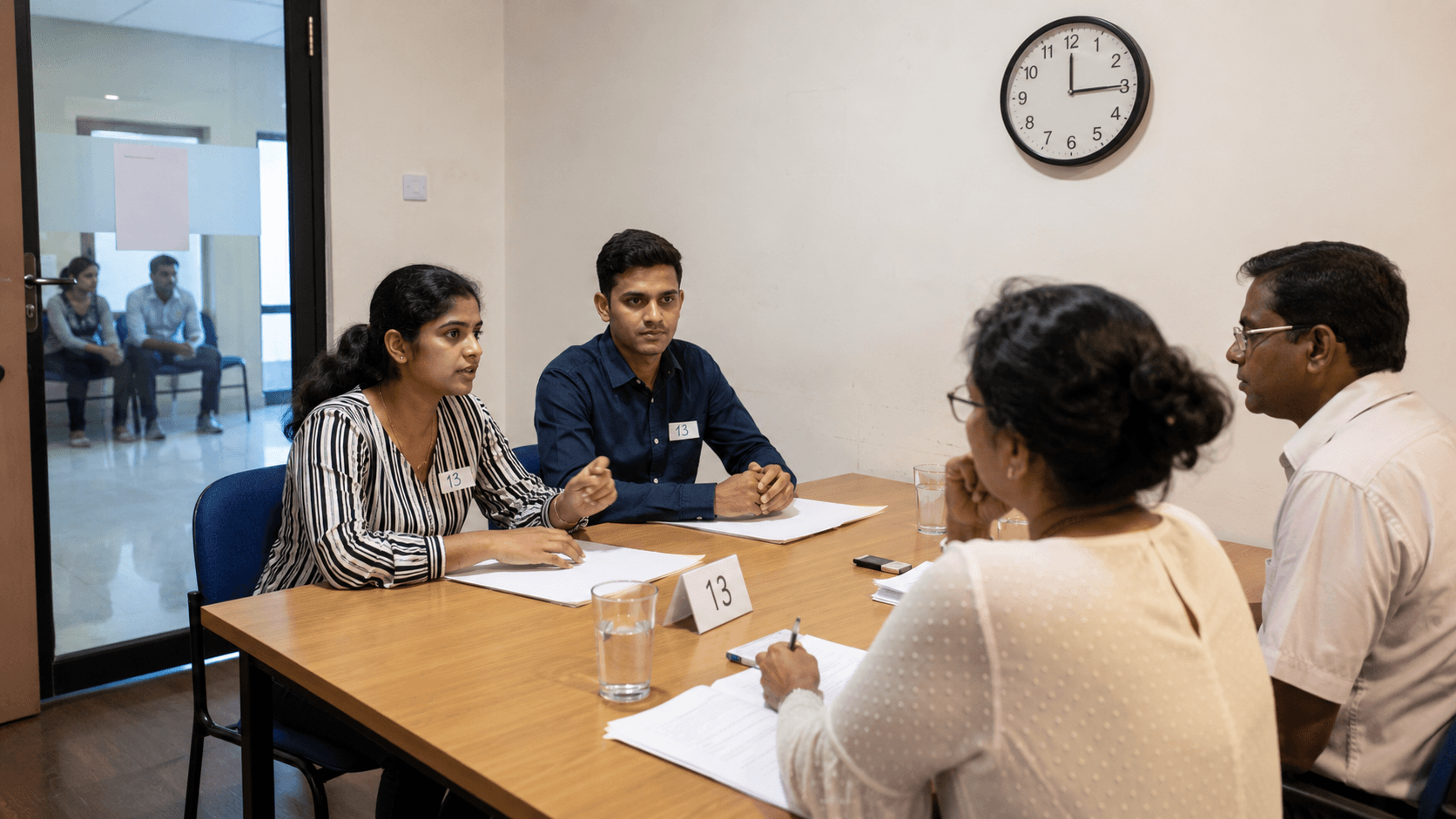
Follow-up and interview preparation: If an employer responds with an interview request, we prepare you for the standard German job interview format, which is structured, formal, and focused on your motivation and knowledge of the occupation.
Contract review: Once an employer offers a contract, we review the Ausbildungsvertrag with you to confirm the terms, training allowance, start date, and location are correct before you sign.
MALIROSA's employer search service is available to candidates who have reached B1 German level and hold a completed A-level or equivalent qualification. If you are still in language training, MALIROSA's German courses are the first step. The employer search opens after B1 is certified.
How Long Does the Employer Search Realistically Take?
German Ausbildung cycles typically begin in August or September each year. The Federal Employment Agency recommends starting your employer search 9–12 months before your target start date. That means if you want to begin training in August 2027, your search should start no later than October or November 2026.
Here is a realistic timeline from the decision to move to Germany to the first day of Ausbildung training:
Total time from A0 German to first day of Ausbildung: approximately 12–18 months for most candidates. This is why MALIROSA advises starting German language preparation immediately upon deciding to pursue the Ausbildung pathway.
What Happens After You Get the Contract
Signing the training contract is not the last step. It is the step that enables all the next steps. Here is the sequence after you have a signed Ausbildungsvertrag:
Federal Employment Agency pre-approval: Either you or your employer submits the signed contract to the BA. The BA checks that the training company is accredited and the position meets legal standards. This takes 2–4 weeks.
Visa application: You submit your application to the German embassy in Colombo with: signed and BA-approved Ausbildungsvertrag, valid passport, German language certificate (B1 minimum), educational certificates with certified German translations, proof of accommodation, health insurance confirmation, and visa application fee.
Biometric appointment: The embassy schedules a biometric data collection appointment. Processing time for the Ausbildung visa is typically 1–3 months.
Visa issued: You receive your national visa (Type D) valid for the duration of your Ausbildung programme.
Arrival in Germany: Within the first two weeks, you must register at your city's registration office (Einwohnermeldeamt, known as Anmeldung), open a German bank account, and enrol in public health insurance through your employer.
Ausbildung begins: Training starts at your company and vocational school (Berufsschule). Your first monthly training allowance arrives at the end of the first month.
Continue Your Journey
Full Ausbildung preparation from language to visa.
Randima Saiger is a co-founder of MALIROSA from Sri Lanka. She brings deep personal understanding of the Sri Lankan education system, family dynamics, and candidate aspirations, bridging local knowledge with Germany-side experience.
Do I need a training contract before applying for an Ausbildung visa?
Yes. A signed Ausbildungsvertrag (vocational training contract) from a German employer is a mandatory document for the Ausbildung visa. The German embassy in Colombo cannot process your application without it. Additionally, the Federal Employment Agency must approve the contract before the visa is issued. Secure the contract first, then apply for the visa.
What German level do I need to find an Ausbildung employer?
Most German employers require B1 as the minimum to even review an application from an international candidate. B2 makes you significantly more competitive, especially in healthcare, IT, and engineering sectors. Your German language certificate (Goethe-Institut or OSD) should be included with every application. Apply before B1 and most applications will be rejected without a response.
Can I find an Ausbildung employer without speaking German?
Not realistically. Even positions advertised in English require German for day-to-day work and for Berufsschule (vocational school) classes, which are conducted entirely in German. A handful of large international companies offer English-taught Ausbildung in IT, but these are rare and extremely competitive. For the vast majority of Ausbildung positions, B1 German is the entry requirement.
How many applications should I send before expecting a response?
Send 15–40 targeted applications. Response rates for international applicants vary by sector: healthcare and care work have higher acceptance rates because the shortage is most acute there; competitive sectors like IT or banking see lower rates. Personalised applications with German-standard CVs and cover letters outperform generic ones significantly. Expect 2–6 weeks between application and response.
Which Ausbildung sectors are most accessible for Sri Lankan applicants?
Healthcare and nursing care (Pflegehilfe, Pflegefachkraft) have the highest vacancy volumes and employer willingness to hire internationally. Hospitality (hotel management, catering) is accessible and has many positions. Logistics, warehouse management, and IT system integration are also viable with the right qualifications. See our dedicated guide on Ausbildung sectors for international candidates.
Does MALIROSA guarantee employer placement?
No. No legitimate service can guarantee an employer will hire you; that decision belongs to the employer. What MALIROSA provides is: professionally prepared German-standard application documents, targeted applications to employers with a track record of hiring international trainees, and full support through the interview and contract stages. Candidates who complete the full MALIROSA preparation process (language training plus application service) have a strong placement track record.
MALIROSA matches Sri Lankan candidates with verified German employers.
Our employer search service prepares your German-standard CV and cover letter, targets companies with a track record of hiring internationally, and supports you through every interview and contract stage. The first step is reaching B1 German. If you are not there yet, start with our language programme and we will open employer search once you certify.
How to Apply for an Ausbildung Visa from Sri Lanka (2026 Step-by-Step Guide)
Most Sri Lankan Ausbildung visa applications are rejected not because candidates lack a training contract, but because their documents are incomplete or incorrectly certified. This step-by-step guide shows you exactly what the German Embassy in Colombo requires and how to avoid the errors that delay most applications by six months.
IT Ausbildung in Germany: Software, Networking and System Integration Training
Germany has 137,000 unfilled IT positions and Fachinformatiker is one of the most recruited Ausbildung tracks in the country. IT Ausbildung pays €800–1,100/month during training. After completion, 74% of trainees receive permanent contracts. This guide covers the 4 specialisations, salary figures, language requirements, and how Sri Lankan STEM graduates approach this pathway.
10 min read
Ausbildung
Nursing Ausbildung in Germany: Salary, Requirements and How to Apply (2026)
Germany has 140,000+ unfilled nursing positions and is actively recruiting internationally. A nursing Ausbildung pays €1,000–1,300/month during training and leads to a qualified salary of €2,800–3,400 after completion. This guide covers the two nursing programmes, real salary figures, language requirements, Sri Lankan degree recognition, and how to find a hospital employer.
10 min read
Our Story
Two Worlds, One Purpose: The Story Behind MALIROSA
MALIROSA grew from a decade of living the exact journey that our candidates are about to begin: between Sri Lanka and Germany, between two cultures, two languages, and two very different sets of expectations.
5 min read
Visa & Pathways
Family Reunion Visa Germany: Who Can Apply, What Is Required, and How Long It Takes
Germany granted over 100,000 family reunion visas in 2023. Most applicants wait between three and twelve months for an appointment at the German Embassy. Understanding the requirements before you apply can cut that wait significantly.